5 Chatbot Privacy Tests SMBs Must Run Before Launch
Run five quick pre-launch tests, lock vendor DPAs, and set conservative retention so your SMB chatbot blocks data leaks and meets privacy obligations.

Treat your website chatbot like any other personal-data collector: require a lawful basis, show a brief AI disclosure, limit what you send to external models, and enforce short, automated retention with real deletion. That means picking a legal basis before launch, not after a complaint. Add a visible AI disclosure at first interaction, sign a data processing agreement with every vendor touching visitor data, and set retention windows you can actually prove work when someone asks you to delete their chat history.
TL;DR:
- Support conversations should be retained for 30 to 90 days, while dispute-related data may need to be kept for 6 to 12 months, depending on legal requirements.
- All copies of chat data, including transcripts, embeddings, analytics, and backups, must be fully deleted to remain compliant with privacy regulations.
- Vendors must provide signed data processing agreements, clear retention settings, and transparent data residency information before deployment.
- Visitors must be informed at the first interaction that they are talking to an AI, under the EU AI Act starting August 2, 2026, with this notice effectively positioned.
- Building privacy by design involves limiting data collection, implementing strict retention policies, and ensuring deletion and export functions are integrated from the start.
Table of Contents
- What Data Chatbots Collect and Where Privacy Risk Appears
- Lawful Basis, Consent, and the AI Act Disclosure Rule
- Who Owns What: Frontend Notices vs. Backend Enforcement
- Retention, Deletion, and Handling Data Subject Requests
- Pre-Launch Checklist: Tests Every SMB Should Run
- Beyond Data Collection: Profiling and Behavioral Risk
- Cross-Border Privacy Challenges for International Chatbot Deployments
- Privacy by Design for Chatbot Development
- Why Conservative Defaults Are Good Business, Not Just Good Compliance
- How Konvuno Helps You Deploy a Privacy-Conscious Chatbot
- Sources
What Data Chatbots Collect and Where Privacy Risk Appears
A chatbot collects more than the message a visitor types. Direct identifiers show up fast: names, emails, phone numbers, order numbers, sometimes payment details typed into a support thread by mistake. The less obvious data is where most operators get caught off guard.
- IP addresses and device IDs, logged automatically by most chat widgets
- Timestamps and session metadata that can reconstruct a visitor’s browsing pattern
- Free-text messages, which can contain anything a visitor decides to paste, including health details or financial information never requested
- Vector embeddings created when a message gets indexed for retrieval augmented generation (RAG)
Free text is the real hazard. A visitor asking “can you help me with my prescription refill order” has just handed you a health-adjacent data point you never designed a field for. System prompts carry their own risk too: any API key, discount code logic, or internal policy text baked into a prompt can leak if a user manipulates the bot into repeating it.
Data doesn’t sit in one place, either. It moves through ephemeral session memory, permanent transcript logs, vector indexes used for RAG, analytics dashboards, and backups. Each layer needs its own retention rule, because a chatbot is a data-collection surface no different from a web form, and it deserves the same scrutiny you’d give a checkout page.
Lawful Basis, Consent, and the AI Act Disclosure Rule
Most SMB support chatbots can run on legitimate interest or contract performance. If a visitor is asking about an order status or a return policy, you’re generally fulfilling a contract or a reasonable business interest, and you don’t need a consent checkbox to answer them. That changes the moment you use conversations to train models, build marketing profiles, or process special categories of data such as health or religious information. At that point, consent becomes the required basis, and you need to document a Legitimate Interest Assessment for the uses that don’t require it.
Statistic Callout: Starting August 2, 2026, the EU AI Act’s Article 50 requires a clear, non-skippable notice telling visitors they’re talking to an AI, delivered at or before the first message exchange. It can’t be buried in a footer link.
Your in-chat privacy snippet and linked policy should cover:
- What data gets collected (messages, metadata, order info)
- Whether messages are sent to a third-party model provider
- Retention period and how to request deletion
- Whether a human ever reviews transcripts
- A direct link to the full privacy policy and a way to reach a person
Skip the consent banner for basic support answers. Add it the moment you start profiling or training on visitor conversations.
Who Owns What: Frontend Notices vs. Backend Enforcement
Privacy compliance splits cleanly across three layers, and confusing them is where most SMB chatbot projects break down.
- Frontend widget. This is where the AI disclosure lives, where a consent toggle appears if you need one, and where a “talk to a human” button gives visitors an exit. It should also carry a visible link to your privacy notice, not a link three clicks deep in the footer.
- Backend server. This is your actual compliance engine. It should sanitize prompts before they reach any external model, cap how much conversation history gets passed as context, enforce your retention schedule automatically, and log every access to a transcript with role-based permissions. A server sitting between your widget and the model is what makes retention and deletion enforceable rather than aspirational.
- Model and vendor layer. Demand a signed data processing agreement (DPA) from every vendor touching visitor text, ask whether the model provider offers a zero-retention setting, confirm where data gets hosted, and get a current sub-processor list with each one’s own retention terms.
One more detail catches SMBs off guard: if your widget sets cookies or starts logging before a visitor clicks anything, you may trigger cookie consent requirements you didn’t intend. Loading the widget only after an active click sidesteps that problem entirely.
Pro Tip: Ask your chatbot vendor directly whether their default model configuration retains your visitors’ conversations for training. If the answer is vague, that’s your answer.
Retention, Deletion, and Handling Data Subject Requests
Retention windows should match why you collected the data, not a default your vendor set for convenience. A reasonable baseline is to retain support conversations for a period sufficient for customer service, sales leads for the resolution period plus some additional time, FAQ and intent logs for a short duration, and dispute-related threads for longer periods to cover potential chargebacks, with exact durations depending on purpose and legal requirements.
Statistic Callout: Recommended retention guidance pins support logs at 30 to 90 days and dispute records at 6 to 12 months, with deletion required to reach transcripts, embeddings, and backups wherever technically feasible.
Deletion only counts if it’s complete. A single “delete” button that clears your primary database but leaves a copy sitting in a vector index or a nightly backup is not compliant, and saying you couldn’t find every copy isn’t a legal defense. Before launch, confirm deletion reaches:
- Live transcripts and session caches
- Vector embeddings tied to that conversation
- Exported analytics reports
- Backup snapshots, on whatever schedule your backup rotation allows
Build export and erasure as actual endpoints, not manual processes buried in a support inbox, and run both before you ever need them for a real request.
Pre-Launch Checklist: Tests Every SMB Should Run
Run these before the widget goes live, ideally in one sitting.
- Vendor due diligence. Get the DPA signed, request the sub-processor list, confirm the model’s retention setting, ask about data residency, and read the breach notification clause.
- Fake sensitive input test. Submit a message containing fake but realistic personal data, then request deletion and verify it disappears from every storage layer, not just the visible transcript.
- Prompt-injection probe. Try to get the bot to repeat its system prompt or reveal internal instructions. If it succeeds, sanitize your prompt structure before launch.
- Export test. Request a data export for a test conversation and confirm the format is usable and complete.
- Access-role audit. Confirm only the staff who need transcript access actually have it, and that access gets logged.
Document what you did: update your Record of Processing Activities, write a short Legitimate Interest Assessment if you’re relying on one, and run a Data Protection Impact Assessment if you’re processing special categories of data at any real scale.
Beyond Data Collection: Profiling and Behavioral Risk
A chatbot doesn’t just store what a visitor types. It builds a behavioral picture across every question asked, every product searched, and every hesitation before a purchase. That’s profiling, and it carries privacy weight even when no name or email ever gets entered.
Consider a visitor who asks a chatbot about pregnancy-safe skincare, then returns three times asking about baby products. No form was filled out, no account created. But a system stitching those sessions together through a device ID or session cookie has effectively inferred a life event, and that inference can feed into marketing segments or personalization models without the visitor ever consenting to it directly.
This is where chatbot privacy diverges from simple data storage. The risk isn’t only “did we keep the transcript too long.” It’s “did we draw a conclusion about this person they never agreed to.” Behavioral analysis built from chat logs can quietly slide into automated decision-making territory, which carries its own disclosure obligations under most privacy frameworks once it starts influencing pricing, offers, or eligibility.

The practical fix is restraint. Don’t feed chat history into a customer scoring model unless you’ve disclosed that use specifically. Don’t let a “smart” recommendation engine draw from conversational data without a documented purpose. And if your chatbot vendor markets “visitor intent scoring” as a feature, ask exactly what data feeds it and where that inference gets stored, because that’s a second data product hiding inside your support tool.
Cross-Border Privacy Challenges for International Chatbot Deployments
A chatbot doesn’t respect borders the way your business entity does. The moment your site serves visitors in the EU, UK, California, and Brazil from the same widget, you’re juggling GDPR, UK GDPR, the CCPA/CPRA, and Brazil’s LGPD simultaneously, each with its own definition of personal data and its own retention expectations.
Data residency becomes a real question fast. A European visitor’s conversation routed through a model hosted in the United States may trigger cross-border transfer rules, and “the server happened to be in Virginia” is not an answer regulators accept. Ask your model provider directly where processing happens and whether regional hosting options exist.
Consent requirements also diverge. What counts as legitimate interest in one jurisdiction might require explicit opt-in in another, particularly around profiling or automated decisions. A retention window that’s generous under one law might exceed what another permits by default.
The practical approach for an SMB isn’t building ten separate compliance programs. It’s setting your defaults to the strictest standard you’re likely to encounter, usually GDPR’s consent and retention bar, and treating regional carve-outs as exceptions rather than the baseline. That single-standard approach costs less to maintain and protects you even in jurisdictions you haven’t mapped yet.
Privacy by Design for Chatbot Development
Privacy by design means building minimization and transparency into the chatbot’s architecture from day one, not patching it in after a data subject request exposes a gap. The Office of the Privacy Commissioner’s framing is direct on this point: privacy has to be an architectural decision, not an afterthought bolted on when a regulator asks questions.
In practice, that means a handful of concrete choices at the development stage:
- Collect only the fields the chatbot actually needs to answer the question, and skip optional fields that just seem useful someday.
- Default every retention setting to the shortest workable window rather than the vendor’s convenient default.
- Mask or redact sensitive text before it ever reaches a vector index, especially in RAG systems where document-level access controls matter as much as the redaction itself.
- Build the deletion and export endpoints alongside the chatbot itself, not as a rushed add-on once the first request arrives.
For any deployment touching health information, the bar goes higher: a business associate agreement, strict role-based access control, encryption at rest, and full audit logs are the baseline expectation, and de-identifying data before it hits analytics or an index is often the only way to use it safely at all.
Why Conservative Defaults Are Good Business, Not Just Good Compliance
The instinct among SMBs is to treat privacy controls as a tax on launching fast. That’s backwards. A chatbot that discloses itself clearly, limits what it stores, and deletes on schedule builds trust with the exact visitors you’re trying to convert into leads or customers.
Konvuno was built around that logic from the start. It’s a configurable AI assistant made for small and medium businesses, installed through a single lightweight widget with no developer work and no per-seat pricing to negotiate. It answers visitor questions straight from your own FAQs, website content, and product catalog, and keeps that catalog current automatically through WooCommerce or Google Merchant and Facebook feeds, so you’re never one stale price away from an awkward conversation. Leads captured through conversation flow into a built-in CRM, and a human takes over the moment a question needs one.
Minimization isn’t a limitation on that model. It’s the default.
— Konstantin
How Konvuno Helps You Deploy a Privacy-Conscious Chatbot
The assistant gives you fewer places for visitor data to leak in the first place. Because answers come from your synced FAQs and product catalog rather than an open-ended model pulling from anywhere, there’s less need to pipe raw customer records or order histories into a prompt just to get a useful answer.
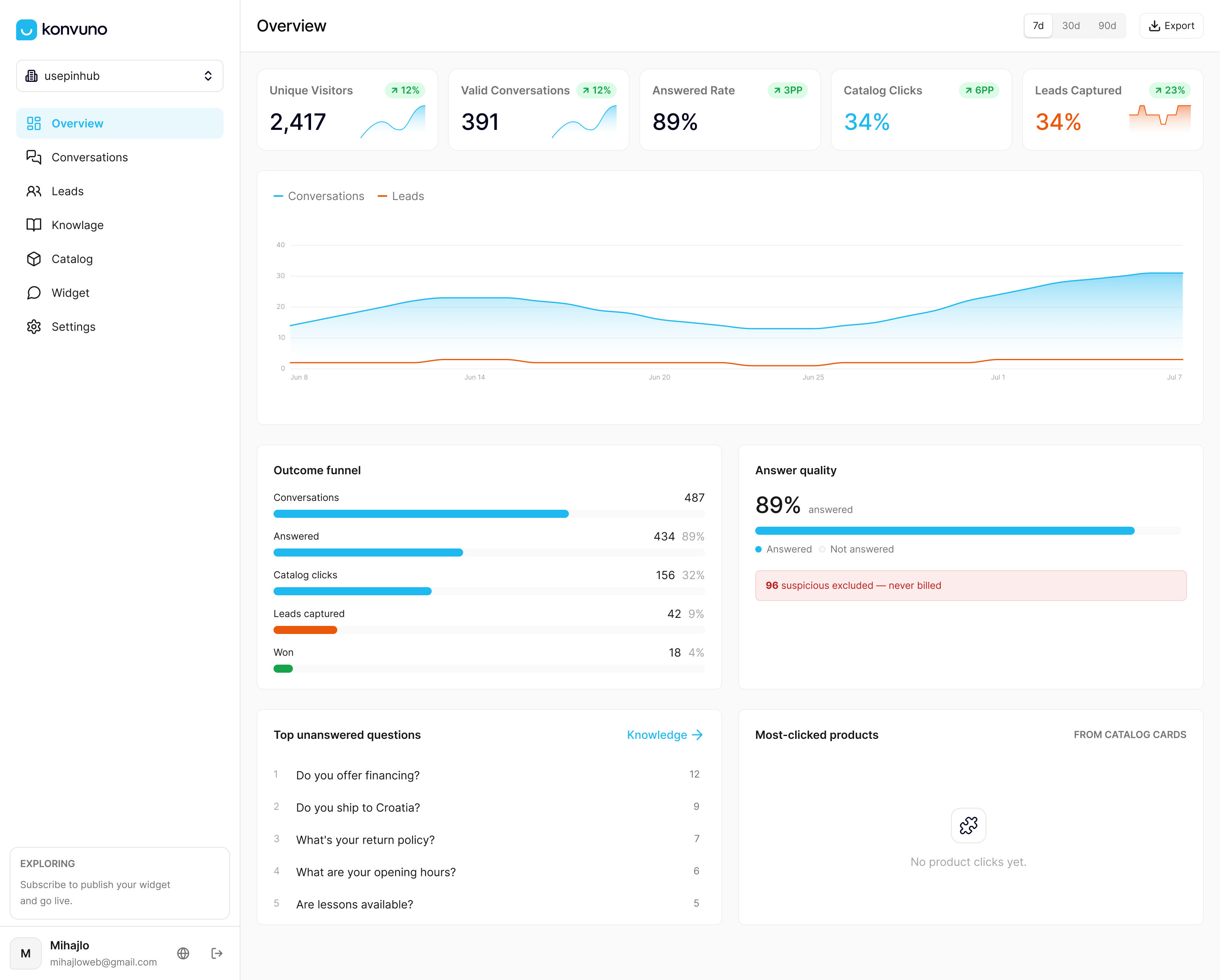
The FAQ Assistant pulls directly from content you already control, so the knowledge base answering your visitors is the same content your privacy policy already describes. Product and pricing questions run through catalog sync rather than a live database query, which keeps sensitive order data out of the conversation entirely. Leads land in one CRM dashboard with clear conversation logs, instead of scattered across whatever tool a chatbot vendor bolted on as an afterthought.
If you’re evaluating a chatbot for your site, or replacing one that’s giving you outdated answers or vague data practices, start with the Konvuno landing page and walk through a demo to see how the setup maps to the controls covered above.
Sources
The guidance above draws on a handful of practical sources worth bookmarking before you configure your own chatbot:
- Build a GDPR-Compliant AI Chatbot: Architecture, Costs & Mistakes to Avoid | Janus Compliance
- Compliance-Ready Chatbots: GDPR, HIPAA, Retention
- Zenku
- Chatbot Security and PII Handling — An SMB Operator’s Guide (2026) — Chatbotscape
This article is general information, not a substitute for advice from a qualified lawyer. Consult a qualified legal professional about your own circumstances before acting on anything here.