Product Teams: Run Chatbot A/B Tests That Work With Low Traffic
Experiment first playbook for product teams. Learn OEC selection, A/A validation, sample size, sequential methods, and low traffic simulations.

Chatbot A/B testing is a randomized comparison of two conversational variants that lets you measure which one produces a better business outcome, such as lead capture or successful resolution. It is worth running whenever you can isolate a measurable change and collect enough conversations to detect a difference, or when traffic is too thin for a live split and a simulated pilot makes more sense.
TL;DR:
- Conversational A/B tests require longer durations and larger sample sizes due to multi-turn interactions and rare trigger events.
- The primary evaluation metric should directly align with the chatbot’s core goal, such as lead capture, resolution, or escalation rate.
- Randomization should be balanced and gradually ramped up, with an A/A test performed beforehand to ensure logging and split integrity.
- Use power analysis to determine necessary sample sizes, especially for binary outcomes, and consider Bayesian or sequential methods for low-traffic bots.
- Testing only one change at a time with clear hypotheses and predefined stop rules increases the reliability of experiment results.
Table of Contents
- What makes conversational A/B tests different from regular UI tests
- Form hypotheses and pick your overall evaluation criterion
- Designing the experiment: randomization, splits, and safety nets
- Sample size, power, and statistical methods
- What to test: prioritized ideas for chatbots and prompts
- Implementation and tooling: running tests and pilots
- Analyzing results and making rollout decisions
- Checklist and minimal experiment template teams can copy
- Author perspective: lessons from running conversational experiments
- A faster way to run and iterate chatbot experiments
- FAQ
- Sources
What makes conversational A/B tests different from regular UI tests
A chatbot test is not a button-color experiment. Conversations carry state across multiple turns, sometimes across sessions, so a change in the opening message can alter behavior five exchanges later in ways a single-page metric never captures. Many chatbot features also trigger rarely: a discount prompt or an escalation flow might fire for a small fraction of visitors, which stretches the time needed to collect a usable sample.
- Multi-turn context means you need to track outcomes at the conversation level, not the message level.
- Low-trigger features often require longer test windows or a different evaluation method entirely.
- Structural changes, like rewriting a whole flow, usually need longer runs than a single prompt tweak.
Form hypotheses and pick your overall evaluation criterion
A good hypothesis names the change, the expected direction, and the metric it should move: “Replacing the open-ended greeting with a three-option menu will increase lead capture rate because visitors resolve ambiguity faster.” That sentence alone tells you what to build and what to measure.
Your Overall Evaluation Criterion (OEC) should be the single metric that best represents success for that chatbot’s job, with a short waterfall of diagnostics behind it in case the primary number is noisy or ambiguous.
- Lead capture rate for assistants whose job is generating sales contacts.
- Resolution rate for support bots, measured as conversations closed without human handoff.
- Escalation rate as a diagnostic, since a drop can mean better bot performance or users giving up.
- Conversation length and drop-off point as secondary signals when the primary metric moves ambiguously.
This structure follows the same logic recommended in the Practical Guide to Controlled Experiments on the Web, which treats OEC selection as a prerequisite for any valid test.
Designing the experiment: randomization, splits, and safety nets
Randomization is what makes the comparison fair, and a 50/50 split between control and treatment gives you the most statistical power for a given amount of traffic, according to the same controlled experiments guide. You can assign variants client-side in the widget using a visitor ID, or server-side through a routing layer if you need consistency across devices and channels.
- Assign variants at first contact and keep the same visitor in the same variant for the full test.
- Ramp treatment gradually, starting around 5 to 10% of traffic, before moving to a full split.
- Keep a rollback switch ready so a broken variant can be pulled without waiting for the test to end.
- Run an A/A test first, comparing two identical variants, to confirm your split and logging are balanced before you trust any real result.
- Watch for contamination: a user who sees both variants across sessions or devices will quietly erode your signal.
Pro Tip: Run your A/A test for at least a few days before launching the real experiment. It costs you time up front but saves you from debugging a false result later.
Sample size, power, and statistical methods

Before launching, estimate how many conversations you need to detect the effect size you actually care about. Skipping this step is one of the most common reasons chatbot tests end inconclusive, since underpowered tests simply run out of traffic before a real difference becomes visible.
For large-scale experiments with binary outcomes, a two-sample t-test performs similarly to a chi-squared test once each variant has roughly 500 or more conversations, according to research on analyzing binary data for large-scale A/B testing. That makes the t-test a reasonable default for conversion-style metrics once you clear that threshold.
- Use power analysis up front to estimate required sample size for your minimum detectable effect.
- Below the large-sample threshold, prefer a chi-squared test or an exact test over a naive t-test.
- Adopt sequential or always-valid testing methods, such as the mSPRT family described by Amplitude’s sequential testing guidance, if your team wants to check results early without inflating false positives.
- For genuinely low-traffic chatbots, consider Bayesian analysis, pooled metrics across similar flows, or an agent-based simulation as a screening step before committing to a live test.
What to test: prioritized ideas for chatbots and prompts
Not every variant idea is worth the traffic it costs. Prioritize changes with a plausible path to moving your OEC over cosmetic tweaks.
- System prompt and instruction wording for LLM-driven assistants, since tone and specificity in the underlying prompt shape every downstream answer.
- Flow structure, comparing a guided, option-based path against an open free-text prompt for the same task.
- Tone and brevity, testing a terse, task-focused style against a warmer, more conversational one, tied directly to your primary metric.
- Trigger logic and personalization, such as when a proactive greeting or CTA appears, and whether referencing a visitor’s browsing context changes engagement.
Changes to the underlying prompt tend to produce the fastest, cleanest signal because they affect every conversation in the treatment group immediately.
Implementation and tooling: running tests and pilots
Three engineering paths cover most chatbot experiments: client-side variant assignment inside the widget, server-side routing when you need consistency across channels, or a feature-flag system if your team already runs flags for other product experiments. For low-traffic bots, agent-based simulation tools such as SimAB or Agent A/B let you run persona-conditioned synthetic conversations to screen ideas before spending real traffic, and published agreement rates with historical outcomes suggest they are a reasonable directional filter, not a replacement for a live test, per the SimAB research.
A website assistant that logs every conversation, captures leads automatically, and keeps its product answers synced to your catalog removes a lot of the manual tracking that usually slows chatbot experiments down.
- Name events consistently across variants (for example,
lead_captured,handoff_triggered) so analysis does not require manual reconciliation. - Group funnel events by conversation ID, not by message, to avoid double-counting.
- Monitor live dashboards for broken flows during ramp-up, not just at the end of the test.
A pilot playbook for internal chatbot testing walks through connecting pilot runs to a broader experimentation system, which is useful if your team is setting this up for the first time.
Analyzing results and making rollout decisions
A statistically significant result is not automatically a meaningful one. Look at the confidence interval around the effect, not just whether it excludes zero, and ask whether the magnitude justifies the engineering cost of shipping the change permanently.
- Check results by segment (new versus returning visitors, device type, language) before declaring a universal win.
- Decide your stop rules and abort criteria before launch, not after seeing early data.
- Avoid peeking at results repeatedly with a fixed-horizon test, since that inflates false positives unless you are using a sequential method.
- Watch for external confounders, like a marketing campaign or seasonal traffic spike, that could explain a shift unrelated to your variant.
The Think with Google Experiments Playbook lists wrong metric selection and missing power analysis among the most common reasons experiments mislead teams, both of which are avoidable with the steps above.
Checklist and minimal experiment template teams can copy
A short template keeps every test consistent and easy to review later.
- Write the hypothesis, naming the change, direction, and mechanism.
- Pick one primary metric (your OEC) and two or three diagnostic metrics.
- Estimate required sample size and expected test duration before launch.
- Set stop rules: a fixed sample size, a sequential boundary, or a calendar date.
- Run the A/A validation check, then launch the ramp.
| Phase | Key actions |
|---|---|
| Pre-launch | Hypothesis, OEC, sample size estimate, A/A test |
| Launch | Ramp-up, event logging, live monitoring |
| Post-launch | Segment checks, confidence interval review, rollout decision |
Author perspective: lessons from running conversational experiments
The biggest mistake I see teams make is testing too many things at once and then arguing about which one caused the result. Pick one change, one metric, and let the data settle it. Pairing the numbers with a quick read of actual transcripts catches problems a dashboard alone will miss, especially when a metric moves for a reason nobody predicted.
— Konstantin
A faster way to run and iterate chatbot experiments
Testing conversational changes gets a lot simpler when the logging and lead capture are already built in. With a configurable AI website assistant like Konvuno, you install a single script tag, configure prompt and flow variants from a hosted dashboard, and watch conversation logs and captured leads update without any developer time.
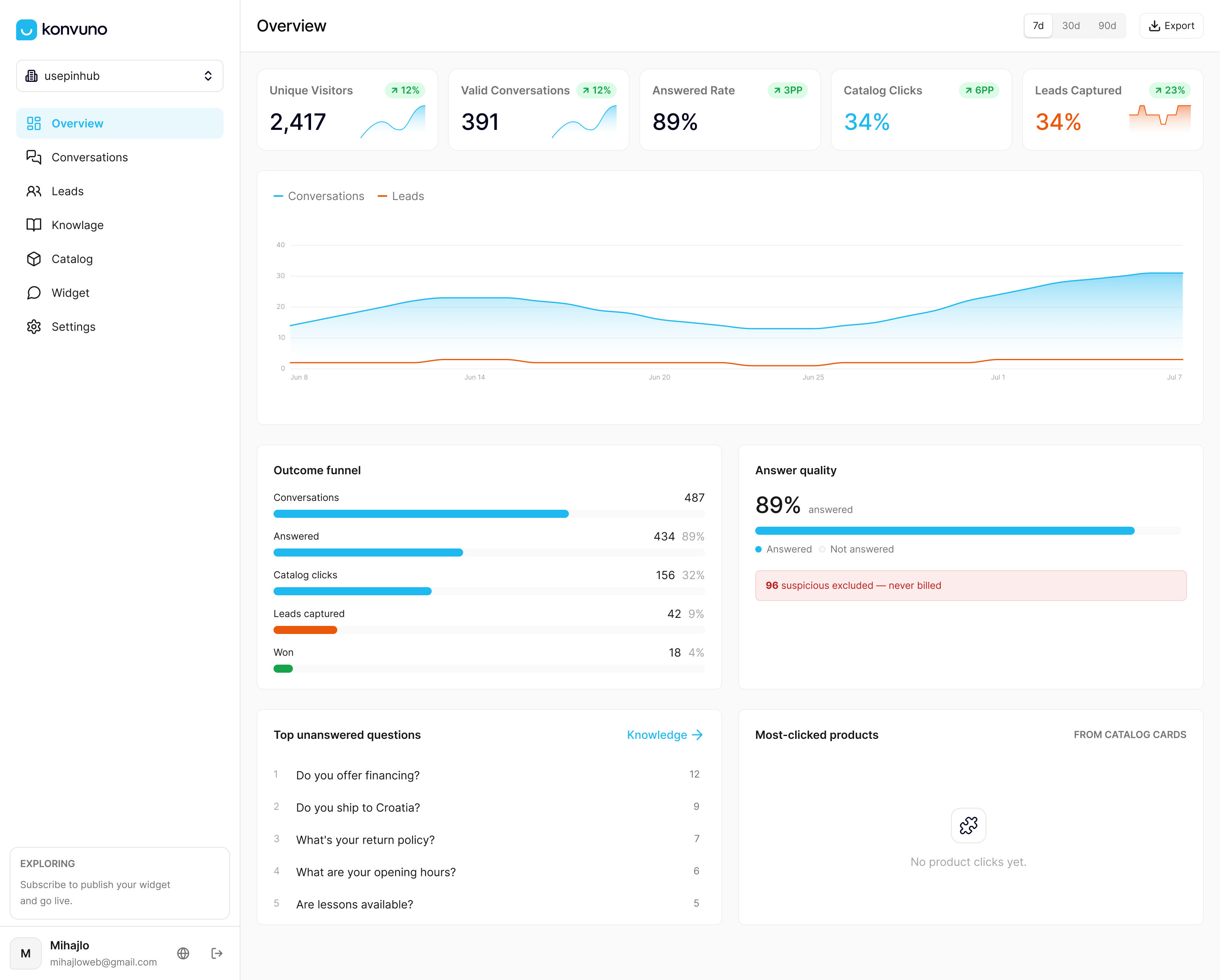
Product catalogs can sync automatically from WooCommerce or a Google Merchant feed, so a variant testing product-related answers stays accurate on its own throughout the experiment. If you want to see how quickly a test can go live, visit Konvuno to start configuring your own assistant.
FAQ
What is A/B testing in AI?
A/B testing in AI means randomly splitting users between two versions of an AI-driven experience, such as a chatbot prompt or flow, and measuring which version performs better on a chosen metric. The Practical Guide to Controlled Experiments on the Web outlines the core principles: randomization, a clear evaluation criterion, and sufficient sample size.
How do I test a chatbot before launch?
Start with a hypothesis and a single primary metric, then run a controlled split between the current version and the new variant, validating your setup with an A/A test first. For low-traffic bots, an agent-based simulation can screen ideas before you commit live traffic to a full test.
What are the four types of chatbots?
Chatbot types are commonly grouped by how they generate responses: rule-based bots that follow scripted decision trees, retrieval-based bots that pull from a knowledge base, AI or LLM-driven bots that generate open-ended answers, and hybrid bots that combine scripted flows with generative responses for flexibility.
Which statistical test should I use for chatbot A/B results?
For binary outcomes like conversion or resolution, a two-sample t-test performs similarly to a chi-squared test once each variant has roughly 500 or more conversations, per PMC research on large-scale A/B testing. Below that sample size, a chi-squared or exact test is the safer choice.
How can a configurable AI website assistant support chatbot experimentation?
Konvuno lets you configure prompt and flow variants from a hosted dashboard without developer involvement, and its conversation logs and built-in lead capture make it straightforward to track which variant performs better. Plans are listed at Konvuno, starting with the Starter plan.
Sources
- Approaches to analyzing binary data for large-scale A/B testing - PMC
- Practical Guide to Controlled Experiments on the Web
- Experiment sequential testing — Amplitude