One Script Tag: Organize Chatbot FAQs for SMBs
SMB playbook to organize chatbot FAQs: one canonical knowledge base with IDs and tags, confidence-based three step fallbacks, and deployment via a single...

Organize FAQs as a single canonical knowledge base with metadata, a retrieval layer, and clear fallback rules, then add retrieval-augmented generation for longer documents. This structure cuts maintenance time, prevents duplicate answers, and gives you fewer dead-end conversations. The rest comes down to execution: query rewriting, context handling, and a review cadence that keeps the content honest.
TL;DR:
- Using a retrieval-first setup helps small and medium businesses avoid hallucinations and maintain easier audit trails compared to RAG or rule-based systems.
- Organize your FAQ knowledge base around one canonical answer per question with stable IDs and detailed metadata to improve retrieval accuracy and simplify updates.
- Incorporate query rewriting and ranking signals like category tags to handle paraphrased questions and refine search results effectively.
- Track conversation context with summaries and slots instead of full history to maintain efficiency and clarity during multi-turn interactions.
- Tag entries with multiple languages, then route questions automatically to the correct version, lowering maintenance costs while supporting multilingual audiences.
Table of Contents
- Choosing an Architecture: Rule-Based, Retrieval, RAG, or Hybrid
- Organizing the Knowledge Base: Canonical Q&A, Metadata, and IDs
- Improving Retrieval and Matching: Query Rewriting and Ranking Signals
- Maintaining Conversational Context: Summaries, Slots, and Fallbacks
- Multilingual FAQ Organization and Routing
- Importing, Deduping, and Scaling Large FAQ Sets
- Evaluating and Monitoring: KPIs and Safety Controls
- SMB Checklist for Organizing Chatbot FAQs
- What Actually Matters in Chatbot FAQ Design
- Organizing FAQs Without the Developer Overhead
- FAQ
- Sources
- Developer Docs and Research Referenced
Choosing an Architecture: Rule-Based, Retrieval, RAG, or Hybrid
Most FAQ chatbots fall into one of three camps. Rule-based systems match exact keywords or decision trees and work for a handful of static questions, but they break the moment a visitor phrases something differently. Retrieval systems search a knowledge base for the closest matching Q&A pair, using either keyword search or semantic embeddings, and handle paraphrasing far better. Retrieval-augmented generation (RAG) pipelines go further by pulling relevant passages and generating a fresh answer from them, which suits long policy documents or product manuals that cannot be reduced to short Q&A pairs.
For most small and medium businesses, a retrieval-first setup is the practical starting point. It is cheaper to run, easier to audit, and less prone to the kind of invented details that RAG can introduce when source passages are thin. Hybrid pipelines that combine retrieval with generation and passage filtering can reduce hallucination risk while keeping replies fluent, which makes them worth adding once your FAQ content grows beyond short answers.
- Rule-based: fastest to build, cheapest to run, brittle with phrasing variation.
- Retrieval: handles paraphrasing well, moderate setup cost, easy to audit.
- RAG/hybrid: best for long documents, higher cost and complexity, needs passage filtering to control hallucination risk.
Phase from retrieval to RAG once your FAQ answers start running longer than a paragraph or require pulling from multiple source documents at once.
Organizing the Knowledge Base: Canonical Q&A, Metadata, and IDs
Every FAQ chatbot needs one rule above all others: each question has exactly one canonical answer, stored once, with a stable ID. Duplicate versions of the same answer scattered across spreadsheets or page content are the single biggest cause of inconsistent replies.
Build your knowledge base around these elements:
- Canonical ID. Assign a unique identifier to each Q&A pair so edits, analytics, and version history all point to the same source of truth.
- Metadata schema. Tag each entry with language, topic or intent category, synonyms and alternate phrasings, a confidence or priority score, and a last-updated date.
- Taxonomy. Group entries into categories such as shipping, billing, returns, or product specs so the retrieval layer can narrow its search and your dashboard can report by topic.
- Versioning and ownership. Assign an owner to each category and log changes, so outdated answers get caught instead of lingering for months.
This structure pays off twice: it improves retrieval accuracy because the system can filter by tag before ranking matches, and it makes maintenance possible for a non-technical owner who just needs to scan a dashboard rather than dig through code.
Pro Tip: Store synonyms and common misspellings directly in the metadata field for each Q&A pair; it catches more real-world phrasing than tuning the retrieval model alone.
Improving Retrieval and Matching: Query Rewriting and Ranking Signals
A visitor rarely types a question the way it appears in your FAQ file. Query rewriting, where the system restates a casual or vague utterance into a cleaner retrieval query, closes much of that gap before the search even runs.
For FAQ corpora of a few hundred entries, keyword search (BM25) often performs competitively with embeddings and costs less to run. Larger or more varied corpora tend to benefit from semantic embeddings that catch paraphrased meaning, with a reranking step that reorders the top candidates using metadata signals like category or recency.
- Rewrite short or ambiguous utterances into fuller retrieval queries before matching.
- Combine BM25 and embeddings, then rerank top results using tags and confidence scores.
- Set a confidence cutoff below which the bot asks a clarifying question instead of guessing.
One of the most reliable fixes for low-confidence matches is asking a narrow, focused question rather than trying to pre-empt every possible phrasing, a pattern Google’s conversation design guidance recommends for resolving ambiguity. A tool like Elasticsearch or a managed vector database can host either retrieval method, but the ranking logic and fallback thresholds matter more than the underlying engine choice.
Maintaining Conversational Context: Summaries, Slots, and Fallbacks

Multi-turn FAQ conversations fail most often when the bot forgets what the visitor already said two messages ago. Passing the full conversation history into every retrieval call is one fix, but it gets expensive and slow as conversations lengthen.
An evolving summary, a short rolling description of what matters so far, updated after each turn, preserves salient context with similar or improved results compared to full-history conditioning while using far less computing per turn. For structured tasks like booking a callback or filtering products by size, slots let the bot collect one piece of information at a time inside a single dialog flow, a pattern IBM Watson Assistant’s tutorials illustrate for reservation-style flows.
- Use an evolving summary instead of full history to track context across turns efficiently.
- Capture structured details with slots when a task needs multiple pieces of information.
- Store stated preferences so later answers can reference them without asking again.
Fallbacks need the same discipline as matching: escalate after around three failed attempts, with each reprompt narrowing the question or offering explicit choices before handing off to a human.
Pro Tip: Make your third fallback message always include a clear path to a human, never a repeat of the same question in different words.
Multilingual FAQ Organization and Routing
A single knowledge base with language tags on each entry is usually easier to maintain than separate per-locale knowledge bases, since updates to a canonical answer only need to happen once before translations follow. The trade-off is that translation quality varies, and a routing layer has to detect language and select the right variant, falling back to a default language when a translation is missing rather than failing silently.
- Tag each canonical entry with its available languages rather than duplicating the whole knowledge base per locale.
- Use a routing engine to detect the visitor’s language and serve the matching variant automatically.
- Reserve human review for your top, highest-traffic intents and let lower-value, long-tail content run on automated translation.
This keeps your highest-impact answers accurate in every language you support while avoiding the maintenance burden of keeping dozens of parallel FAQ sets in sync.
Importing, Deduping, and Scaling Large FAQ Sets
Moving a large spreadsheet of questions and answers into a chatbot without cleanup just imports the mess. Cluster near-duplicate questions by embeddings or simple keyword similarity before import, and pick one canonical answer per cluster rather than keeping every variant.
- Cluster and canonicalize similar questions first, merging duplicates into a single entry with one approved answer.
- Map your CSV columns to required fields: question, canonical answer, category, language, and an ID column for tracking.
- Run sanity checks after import, searching for near-duplicate IDs, missing categories, or blank answers.
- Roll out incrementally, publishing one category at a time so errors surface before the whole FAQ set goes live.
Evaluating and Monitoring: KPIs and Safety Controls
A chatbot’s FAQ quality is only visible through its metrics. Track the no-match rate (how often nothing meets your confidence cutoff), the acceptance rate (how often visitors treat an answer as satisfactory), the escalation rate to a human, and average time to resolution.
- Review analytics weekly to spot questions your knowledge base does not yet cover.
- Flag answers with high escalation rates for a content rewrite, not just a retrieval tweak.
- Run periodic human review of generated or auto-translated answers, since ongoing human oversight of AI-generated content remains necessary even after a pipeline is tuned.
Rigorous evaluation pipelines that compare retrieval approaches side by side, a practice formalized in TREC conversational-assistance research, consistently find that passage filtering and summarization improve grounded answer quality over raw retrieval alone. Treat your own FAQ bot the same way: A/B test a change before rolling it out everywhere.
SMB Checklist for Organizing Chatbot FAQs
Before launch, run through a short list: canonicalize every duplicate question, tag each entry with language and category, choose a retrieval method sized to your content volume, configure escalating fallback prompts, and set a monthly review cadence.
- Canonicalize first: one ID, one answer, no duplicates across spreadsheets or pages.
- Tag everything with language, category, and confidence before worrying about ranking tweaks.
- Pick retrieval sized to your corpus, then layer in generation only where answers run long.
- Configure three-step fallbacks ending in a human handoff, never a repeated question.
A hosted dashboard that shows which questions visitors actually ask, paired with a feed-synced FAQ assistant, makes this checklist realistic for a small team without a developer on staff.
What Actually Matters in Chatbot FAQ Design
Most advice on this topic obsesses over model choice: which embedding, which large language model, which vector database. That misses where FAQ chatbots actually fail for small businesses, which is content hygiene. A mediocre retrieval setup over a clean, deduplicated, well-tagged knowledge base beats a sophisticated RAG pipeline over messy, duplicated content every time.

The conventional advice also underrates fallback design. Teams spend weeks tuning confidence thresholds and almost no time writing the three escalating reprompts a visitor sees when nothing matches well, yet that sequence is what determines whether a frustrated visitor abandons the chat or reaches a human calmly.
If you are starting from zero, prioritize in this order: canonicalize and tag your content first, write deliberate fallback prompts second, and only then spend time on retrieval tuning or adding generation. Teams that reverse this order end up polishing a matching algorithm that is searching through duplicate, untagged chaos.
— Konstantin
Organizing FAQs Without the Developer Overhead
We built Konvuno so the structure described above doesn’t require a development team to maintain. You install one script tag, then manage your canonical knowledge base, tags, and fallback behavior from a hosted dashboard, with answers pulled from FAQs, site content, and product catalogs.
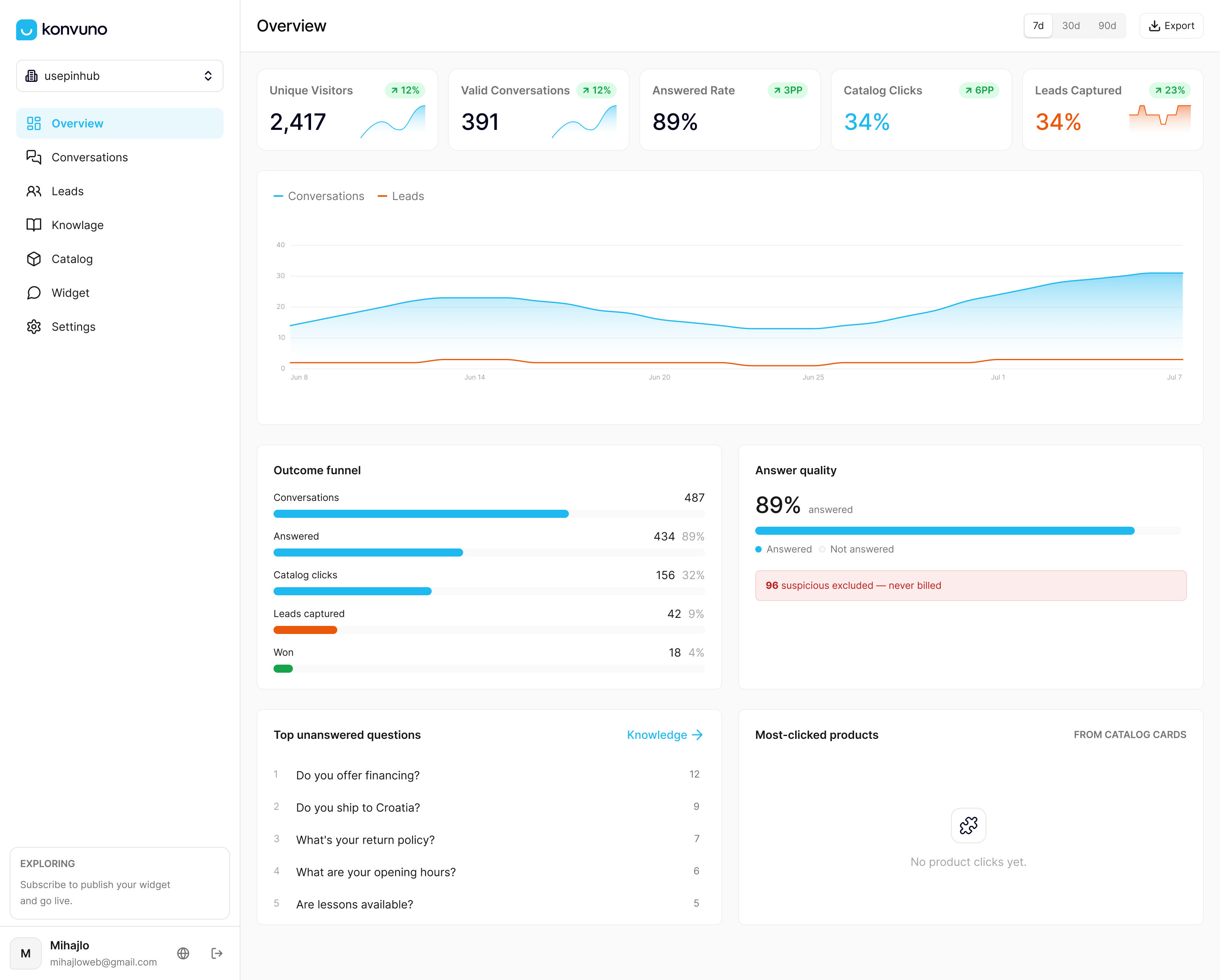
Product catalogs sync automatically from WooCommerce, Google Merchant, or Facebook feeds through Shop Connect, so pricing and availability answers stay current without manual edits. The assistant supports multiple languages and hands off to a human when a question needs one.
- Best fit: SMB owners and agencies who want FAQ automation without hiring a developer.
- Includes: dashboard analytics on what visitors actually ask, plus built-in lead capture.
Starter plans begin at a low monthly price, with Growth and Business tiers available for larger catalogs; compare plans and configure before paying.
FAQ
How do I organize FAQs in a chatbot for better accuracy?
Build one canonical knowledge base where each question has a single answer, a stable ID, and metadata like category and language. Pair it with a retrieval layer and confidence-based fallbacks so unclear questions get a clarifying reprompt instead of a guess.
What are 5 things I should avoid discussing with a chatbot?
Avoid sharing sensitive financial account numbers, medical diagnoses, legal advice requests, passwords or login credentials, and anything you would not want stored in a conversation log. Most FAQ bots are built to answer product and policy questions, not to handle sensitive personal decisions.
How do you maintain context in a chatbot?
An evolving conversation summary, updated after each turn, preserves the salient details of a conversation efficiently without passing the full chat history into every retrieval call. Slots handle structured multi-step tasks, like booking a callback, by collecting one piece of information at a time.
What are the four types of chatbots?
Common categorizations include rule-based (decision-tree) bots, retrieval-based bots that match questions to a knowledge base, generative bots that write novel replies, and hybrid bots that combine retrieval with generation. Most practical FAQ chatbots for small businesses use retrieval or a retrieval-generation hybrid rather than a purely rule-based or purely generative approach.
What should I avoid asking a general AI chatbot?
Avoid questions that require real-time or highly specialized professional judgment, like current legal rulings, medical diagnoses, or live financial data, since general chatbots can produce confident but incorrect answers outside their training or retrieval scope. For FAQ-style bots, questions well outside the configured knowledge base are better met with a fallback to a human than a generated guess.
Sources
- Conversation design | Google for Developers
- Implementation tips (Dialogflow) | Google for Developers
- Evaluating Full Dialogue History vs. Summarized Context for Personalized Knowledge Assistance
- Sequencing Matters: A Generate-Retrieve-Generate Model for Building Conversational Agents
- Adding a node with slots to a dialog | IBM Cloud Docs
Developer Docs and Research Referenced
For readers who want to go deeper on the technical side, these sources cover the specific mechanisms discussed above: conversational context handling, retrieval pipeline design, and fallback patterns.
- Evaluating Full Dialogue History vs. Summarized Context for Personalized Knowledge Assistance
- Sequencing Matters: A Generate-Retrieve-Generate Model for Building Conversational Agents
- Conversation design | Google for Developers
- Implementation tips (Dialogflow) | Google for Developers
- Adding a node with slots to a dialog | IBM Cloud Docs