Three Research Backed Checks to Ship Chatbot Prompts for AI Teams
Research backed prompt engineering for AI teams. Use stability, mutual information, NLL, and query entropy metrics, add injection defenses, and run three...

Effective prompt engineering for chatbots means designing inputs and prompt architecture that maximize three things at once: reliability across repeated runs, resistance to manipulation, and consistent task accuracy. The highest-leverage moves are structured prompts with clear delimiters, layered guardrails for retrieval-augmented systems, and automated evaluators that score prompt quality before you ever deploy.
TL;DR:
- Keep system instructions, refusal rules, retrieved context, and user queries in separately delimited sections; use diverse examples and reserve stepwise reasoning for complex tasks.
- Test every prompt change on a versioned set of representative queries, repeating runs to measure stability; semantic stability correlates with task success (r=0.73).
- A tested defense combining filtering, guardrails, and verification cut successful injections from 73.2% to 8.7%, while retaining 94.3% of baseline performance.
- Require human approval before refunds, account changes, or cancellations, and treat every retrieved document as untrusted until filtering and provenance checks clear it.
- Automate scoring and track accuracy, response variance, token use, latency, and model drift; fine tune only after prompt optimization stalls and labeled data supports training.
Table of Contents
- How system prompts, user prompts, and context work together
- Measuring prompt quality: stability, mutual information, and entropy
- Templates and techniques that improve chatbot responses
- Defending RAG chatbots against prompt injection
- Scaling prompt quality with automated evaluation pipelines
- A practical checklist before you ship a prompt-driven chatbot
- Balancing research rigor with shipping deadlines
- A managed option for teams that would rather not build this stack
- FAQ
- Sources
How system prompts, user prompts, and context work together
A production chatbot prompt is rarely one block of text. The system prompt carries persistent instructions, tone, and constraints; the user prompt carries the live query. Keeping them separated, rather than concatenating everything into one string, is the first line of privilege separation: it limits how much of the model’s behavior a user’s input can override.
In-context learning lets you steer behavior without fine-tuning. Zero-shot prompts rely on instructions alone; few-shot prompts add worked examples so the model infers the pattern. For multi-step reasoning tasks, chain-of-thought prompting, asking the model to reason before answering, often improves accuracy on tasks with logical or arithmetic structure.
Modular composition treats a prompt as four parts: an immutable core instruction set, a guard layer that restricts scope and refuses unsafe requests, a context block holding retrieved or session data, and the user query itself. Keeping these parts distinct, with explicit delimiters, makes a prompt easier to test, version, and debug when something goes wrong.

Measuring prompt quality: stability, mutual information, and entropy
Ad-hoc tweaking does not scale. Once a chatbot handles real traffic, you need metrics that tell you whether a prompt change actually helped.
- Semantic stability measures how consistent a model’s outputs are across repeated runs or paraphrased inputs, and it correlates with downstream task success.
- Mutual information and negative log-likelihood (NLL) signals quantify how confidently a model’s output depends on the prompt content, useful for spotting prompts that produce noisy or underdetermined completions.
- Query entropy flags prompts that produce highly variable responses to similar inputs, a proxy for fragility.
- LLM-as-a-judge evaluation replaces brittle string-matching with model-based scoring, reducing false negatives when a correct answer is phrased differently than expected.
One study reports a strong positive correlation (r=0.73) between semantic stability and task success, which means prompt stability is not a cosmetic property. It is a leading indicator of whether a prompt will hold up in production. A meta-analysis of more than 150 prompting studies found that improving a single, well-chosen property often beats stacking multiple changes at once, and recommends metric-driven evaluation over intuition.
Much of what looks like “prompt sensitivity” in published benchmarks is partly an artifact of how outputs are graded rather than a true model flaw; switching to LLM-as-a-judge scoring reduces that measurement noise and gives a more accurate read on true robustness.
Templates and techniques that improve chatbot responses
A few concrete patterns consistently outperform loosely written prompts.
- Build a modular template: immutable system core, a guard clause stating what the assistant must refuse, an explicitly delimited context block for retrieved data, and the user query last.
- Select few-shot examples for diversity, not just correctness, covering edge cases, ambiguous phrasing, and the range of real user intents, not three variations of the same easy question.
- Scaffold chain-of-thought reasoning only where the task needs it: multi-step lookups, comparisons, or policy checks, since added reasoning steps cost tokens and latency without always improving simple factual answers.
- Enforce output format with a schema or strict template (JSON keys, fixed headers) so downstream code can parse responses without fragile regex.
- Test with repeated executions, not a single run, and track variance alongside accuracy so you catch unstable prompts before launch.
Controlled natural language approaches, which apply software-engineering discipline like linting and structured syntax to prompt text, have been shown to reduce ambiguity in prompts and make their behavior more predictable across versions. If your chatbot handles multiple conversational threads, pulling in prior turns as context, the same diversity principle applies to selecting which history to retain; our notes on intent training with 10 to 20 examples cover a related selection problem for training data.
Pro Tip: Keep a small, versioned “golden set” of test queries and rerun it against every prompt change before shipping.
Defending RAG chatbots against prompt injection
Retrieval-augmented chatbots introduce a specific risk: the content you retrieve from your own knowledge base can carry adversarial instructions if an attacker has poisoned a document, a web page, or a user-submitted field. The OWASP guidance on prompt injection categorizes attacks into direct injection (malicious text in the user’s own message), context manipulation (poisoned retrieved documents), instruction override (attempts to replace the system prompt), and data exfiltration (tricking the model into leaking its instructions or other users’ data).
A layered defense works better than any single control:
- Pre-retrieval filtering, including embedding-based anomaly detection on documents before they enter the context window.
- Hierarchical guardrails that keep system instructions, retrieved context, and user input in clearly delimited, separately privileged sections.
- Post-response verification, where a second model or guardrail checks the output before it reaches the user.
A combined filtering, guardrail, and verification pipeline reduced successful injection attacks from 73.2% to 8.7% while retaining 94.3% of baseline task performance in benchmark testing, evidence that defense-in-depth is worth the added complexity for any chatbot handling untrusted input. For actions with real consequences, refunds, account changes, appointment cancellations, add a human-in-the-loop approval step rather than letting the model act autonomously. Our guide to chatbot security controls walks through implementation details for smaller teams. Teams building agents that also send or receive email as part of a workflow should scope those permissions tightly; Sendmux’s agent mailbox infrastructure is one way to isolate email actions behind their own API keys rather than giving a model direct inbox access.
Pro Tip: Treat any retrieved document as untrusted input until it passes through your filtering layer, even content from your own site.

Scaling prompt quality with automated evaluation pipelines
Manual prompt review does not scale past a handful of test cases. Execution-free evaluators, models trained to predict multi-dimensional quality scores without running the full pipeline, let you score hundreds of prompt variants quickly and get interpretable feedback on what to fix. A unified evaluator-optimizer pipeline reports that this approach outperforms static-template baselines and some query-dependent methods, while remaining explainable enough to guide manual edits.
On the optimization side, metric-guided revision loops rewrite a prompt, score it, and iterate automatically. Modular frameworks like DSPy separate the program logic from the prompt parameters, letting an optimizer tune wording and few-shot selection against a chosen metric instead of hand-editing text. Reach for fine-tuning only when prompt optimization plateaus and you have enough labeled data to justify the training cost.
Track these signals continuously, not just at launch:
- Validation accuracy on your golden test set.
- Stability variance across repeated runs of the same query.
- Token usage and latency per response.
- Behavior drift as underlying models get updated.
A practical checklist before you ship a prompt-driven chatbot
Before launch, run three checks: build a seed corpus of representative queries, repeat each one multiple times to confirm stability, and simulate injection attempts against any retrieval-backed content, verifying provenance on every retrieved document.
- Prelaunch: stability testing, injection simulation, and document provenance checks.
- Runtime monitoring: track stability drift, hallucination or fact-checking rate, tokens per response, and set error budgets for when a prompt needs review.
- Operational controls: version every prompt change, require human approval for high-risk actions, keep rollback history, and document what each guard clause is meant to prevent.
Our conversation design guidance for production teams covers how to operationalize monitoring without a dedicated ML team.
Balancing research rigor with shipping deadlines
Teams that chase aggressive prompt optimization before locking down stability and safety end up debugging production incidents instead of improving accuracy. Measure first, automate evaluation next, then optimize. Small, versioned experiments with real tests beat clever one-off prompts that nobody can reproduce six months later.
— Konstantin
A managed option for teams that would rather not build this stack
Not every team needs to build a custom evaluation pipeline. For small and medium businesses, we built Konvuno as a configurable website assistant you set up from a hosted dashboard, no prompt engineering team required.
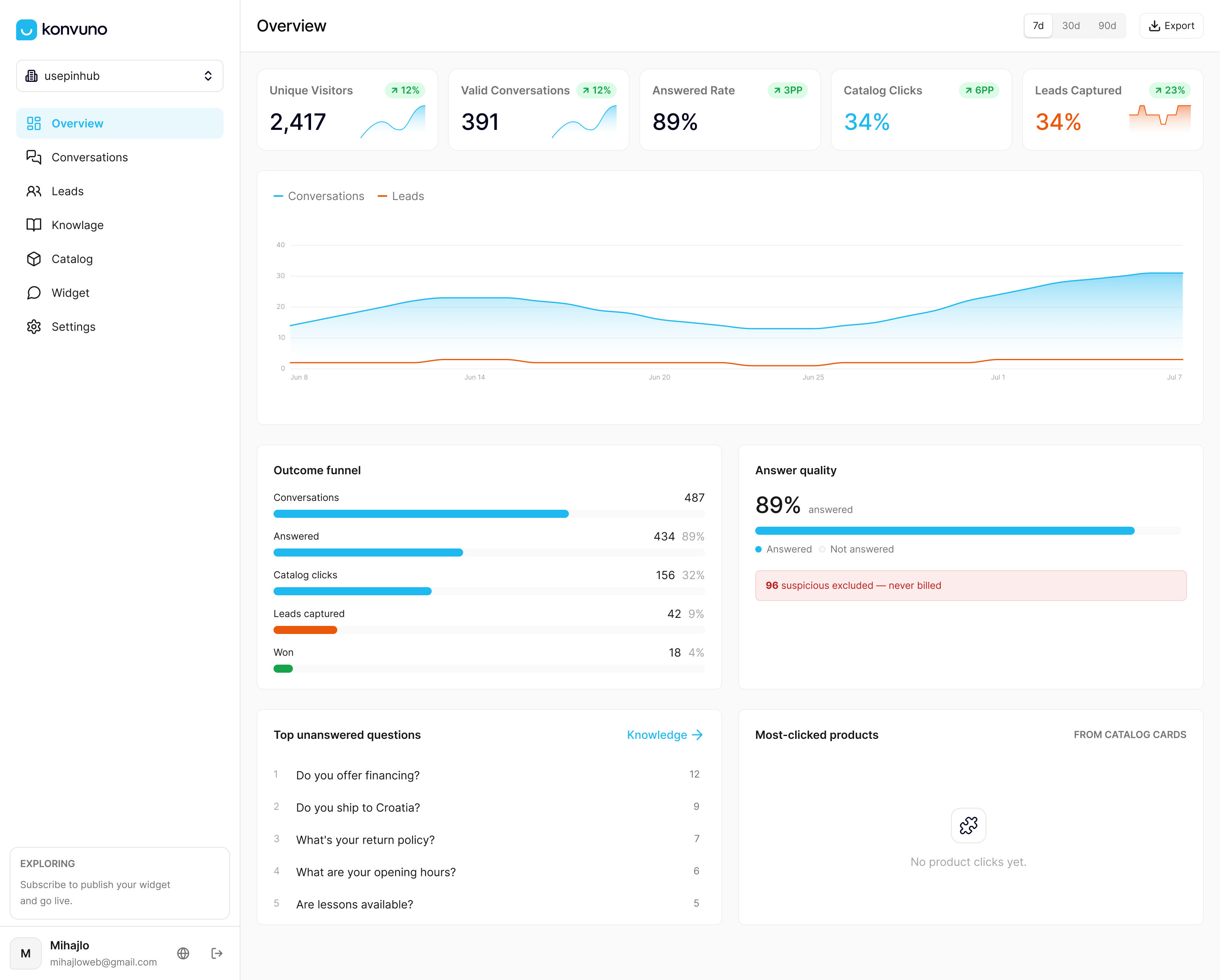
Our assistant answers from your FAQs, site content, and product catalog, with automatic sync from WooCommerce, Google Merchant, or Facebook feeds through our catalog sync feature, captures leads into a built-in CRM, and hands off to a human when a question needs one. It supports multiple languages and installs with a single script tag. If you want the reliability this guide describes without maintaining the underlying stack, see our plans and pricing.
FAQ
What are the best prompts for chatbots?
The strongest chatbot prompts separate system instructions from user input, use explicit delimiters around retrieved context, and include a small set of diverse few-shot examples. Research on prompt stability shows that prompts producing consistent outputs across repeated runs also tend to score higher on task success, so stability testing matters as much as initial wording.
Can you legally marry a chatbot?
No jurisdiction recognizes marriage between a person and a chatbot or AI system, since legal marriage requires two human parties under applicable family law. This question falls outside prompt engineering and chatbot design entirely.
What is the best tool for AI prompt engineering?
There is no single best tool; teams typically combine a modular framework like DSPy for optimization with an execution-free evaluator for scoring and an LLM-as-a-judge setup for testing. The right combination depends on whether you need fine-grained control over prompt parameters or a managed assistant that handles prompt design internally.
Which AI technique is used in chatbots?
Modern chatbots typically combine few-shot or zero-shot prompting, chain-of-thought reasoning for multi-step queries, and retrieval-augmented generation to ground answers in current data. Layered defenses such as embedding-based filtering and output verification are increasingly standard wherever retrieval introduces untrusted content, as described in OWASP’s prompt injection guidance.
Sources
- LLM Prompt Injection Prevention Cheat Sheet — OWASP Cheat Sheet Series
- Prompt Stability Matters: Evaluating and Optimizing Auto-Generated Prompt in General-Purpose Systems