GDPR for Live Chat: What Small Businesses Must Do
GDPR for live chat explained for small business owners: when it applies, which lawful basis fits, what to tell visitors, and how to set up your chat provider.

If your website chat can be used by people in the EU, GDPR applies to it, wherever your business is based. A compliant chat comes down to six things: a lawful basis for each use of chat data, a clear notice at the point of chat, a written contract with your chat provider, a retention period you actually enforce, a way to find and delete one person’s conversations, and a plan for breaches. None of this needs a lawyer on retainer or a developer. It needs a few decisions, made once and written down, and a chat tool whose settings let you carry them out.
TL;DR
- GDPR reaches non-EU businesses that offer goods or services to people in the EU, or monitor their behavior. A US shop shipping to Europe is in scope.
- A chat message is personal data as soon as it can be tied to a person. Names, emails, IP addresses and cookie IDs all count.
- Answering a visitor’s question usually does not need consent. Saving full logs, feeding a CRM, marketing or training AI models may.
- Tell visitors who runs the chat, why you keep the messages, who receives them, for how long, and whether a bot or a person is answering.
- Sign a processor contract with your chat vendor, set retention, and be able to export and delete one person’s chats on request.
Table of Contents
- When GDPR applies to your chat widget
- What personal data a chat collects
- Choosing a lawful basis
- What your privacy notice must say about chat
- Choosing and configuring a chat provider
- Retention: decide a number and stick to it
- Handling access and deletion requests
- Breaches: know the clock
- A checklist before you switch the chat on
- Multilingual chat and GDPR
- Our view on chat and privacy
- Konvuno for small business sites
- FAQ
- Sources
When GDPR applies to your chat widget
GDPR is the European Union’s data protection regulation. The European Commission explains that it covers a company established outside the EU that offers goods or services, paid or free, to people in the EU, or monitors their behavior. Small businesses are not exempt. Some duties, such as appointing a data protection officer, fall away when processing is not a core activity and creates no risk, but the core rules still apply.
In practice, ask three questions:
- Do you sell, ship or take bookings from people in the EU?
- Is your site available in an EU language, or priced in euros?
- Do you track what EU visitors do on your site?
A yes to any of them means you should treat your chat as in scope. A local plumber in Ohio with no EU audience is a different case. A web shop with a German-language storefront is not.
The United Kingdom has its own version, UK GDPR, which follows the same structure. If you serve UK visitors, the guidance below holds, and the UK regulator’s guidance is a useful reference for the lawful basis question.
What personal data a chat collects
Owners often think of chat data as just the text of a message. It is more than that. The Commission’s list of personal data includes a name, an email address, location data, an IP address, a cookie ID and an advertising identifier. A chat session can involve most of these at once:
- The messages themselves, which visitors fill with order numbers, phone numbers, addresses and sometimes health or financial details you never asked for.
- Whatever a pre-chat form collects: name, email, phone.
- Technical data: IP address, device, page URL, session identifiers.
- Anything your tool adds afterward, such as a lead record in a CRM.
The regulation says data should be adequate, relevant and limited to what is necessary for the purpose. That principle is your best design guide. If the chat can answer a shipping question without an email address, do not ask for one. Our guide to what to ask and what to skip in a pre-chat form walks through the fields most small sites can drop.
Choosing a lawful basis
Every use of personal data needs one of six legal grounds under Article 6. The Commission lists them: consent, contract, legal obligation, public task, vital interests and legitimate interests. For a small business chat, three matter.
Contract. If a visitor asks about an order they placed or a quote they requested, answering is part of delivering or preparing that contract. The UK regulator notes that this ground also covers steps taken before a contract at the person’s request.
Legitimate interests. Answering general pre-sales questions on your own site is a normal business interest, and the visitor expects a reply. You must still weigh that interest against the visitor’s rights. The same ICO guide warns that “necessary” is more than useful or standard practice: processing must be objectively needed for the stated purpose.
Consent. Consent is valid only if it is freely given, informed, specific, given by a clear affirmative act, in plain language, and as easy to withdraw as to give. It is not free if you make it a condition of using the service when the data is not needed for that service. A pre-chat form that demands a phone number and a marketing opt-in before anyone can type a question fails that test.
A workable rule of thumb: the immediate job of answering a question rests on contract or legitimate interests. Anything beyond that job, such as keeping full logs for long periods, adding the person to a newsletter, linking the chat to a CRM profile for follow-up marketing, or using transcripts to train an AI model, should have its own basis, and for marketing that is usually an explicit opt-in. Record your choice for each purpose in a short table. Regulators ask to see your reasoning, not a certificate.

What your privacy notice must say about chat
Articles 13 and 14 require you to give people information about processing in a concise, transparent, intelligible and easily accessible form, in clear language, at the moment the data is collected. For chat, that means a short line in or beside the widget, linking to a fuller section of your privacy policy. Cover these points:
- Who you are and how to contact you.
- Why you process chat data and on what legal basis.
- What you collect: messages, transcripts, contact details, technical identifiers.
- Who handles the conversation: an automated assistant, a person, or both, and whether any decision with significant effect on the visitor is made automatically (a product Q&A bot normally makes none).
- Who receives the data: your chat vendor and any other processors.
- How long you keep it.
- Rights to access, correct, delete and object, and the right to complain to a regulator.
- Transfers outside the EU/EEA and the safeguards used.
Telling people they are talking to an AI is good practice and part of being transparent about who handles the exchange. Put it in the widget’s greeting, not buried in a policy page.
Make sure the widget itself loads over a secure connection. Our note on chatbot HTTPS requirements covers what your site needs.
Choosing and configuring a chat provider
When a vendor hosts your chat, you are normally the controller, the party that decides why and how data is used, and the vendor is your processor. GDPR expects you to use a processor that gives sufficient guarantees of appropriate technical and organizational security and to put the processing under a binding Article 28 contract. That contract describes the subject, duration, purpose, type of data and categories of people involved.
Before you sign up to any tool, get answers in writing to these questions:
| Question | What a good answer looks like |
|---|---|
| Is there a data processing agreement? | A signed or click-through contract that covers Article 28 points |
| Who are the subprocessors? | A named list, with the countries they operate in |
| Where does data go? | If it leaves the EU/EEA, a valid transfer mechanism such as the Commission’s standard contractual clauses |
| Who can see transcripts? | Role-based access, with your team’s logins controlled by you |
| Can you set retention? | A configurable period, plus deletion on demand |
| What happens when you leave? | Export and deletion of your data on request |
Transfers outside the EU/EEA fall under Chapter V of the regulation and need a valid mechanism, such as the standard contractual clauses the Commission has approved. The clauses also address confidentiality, security and limits on who can access data.
On your side of the contract, restrict who in your business can open conversations, use unique logins, and turn off any capture you do not need. The seven website chatbot security controls we published are a practical starting list, and the five privacy tests to run before launch help you confirm the setup works.
Retention: decide a number and stick to it
GDPR does not give a fixed number of days. It says you should keep personal data no longer than necessary for the purpose. So you choose a period and be ready to justify it. Support chats about a finished order may need a short window to handle follow-ups or complaints. Leads you have consent to contact may be kept while the consent stands. Transcripts that contain nothing but product questions can often go quickly.
Write the period down next to each purpose, set it in your tool, and mention it in your notice. Our guide to how long to keep chatbot conversations explains how to pick sensible periods by purpose.
Handling access and deletion requests
Visitors can ask what you hold on them, ask you to correct it, or ask you to delete it. The right to erasure applies, among other cases, where the data is no longer necessary for its purpose, consent is withdrawn, the person objects or processing is unlawful. Retention stays lawful where you need the data for a legal obligation or to defend a legal claim.
A small business does not need a complex system. It needs a routine:
- Name one person who receives requests, and publish an email address for them.
- Confirm who is asking before releasing anything.
- Search the chat history and the lead records for that person’s email or name.
- Export what you find, or delete it, and note the date.
- Tell your processor if the request affects data it holds.
This is much easier when contact details are stored separately from raw transcripts, and when your tool lets you find a conversation by person. Test the process once before a real request arrives. Pick a dummy conversation and time how long it takes to find and remove it.
Breaches: know the clock
If personal data in your chat is exposed, for example through a compromised team login, a breach notice to your regulator is generally due within 72 hours of becoming aware unless the breach is unlikely to risk people’s rights. Your processor must tell you without undue delay so you can meet that deadline. Decide in advance who in your team receives such alerts and who contacts the regulator. Strong passwords, two-step login and limited staff access prevent most small-business incidents.
A checklist before you switch the chat on
| Step | Done when |
|---|---|
| Scope | You know whether EU or UK visitors use your site |
| Purposes | Each use of chat data is listed |
| Lawful basis | Each purpose has a basis, and marketing has an opt-in |
| Notice | The widget points to a plain-language privacy section |
| Contract | A processing agreement and subprocessor list are on file |
| Form | The pre-chat form asks only for what the chat needs |
| Retention | A period is set in the tool and stated in your notice |
| Requests | One person owns access and deletion requests |
| Security | Logins are unique, access is limited, the site uses HTTPS |
Multilingual chat and GDPR
If you serve visitors in several languages, the notice must be intelligible to each of them. A privacy line in English above a chat that answers in Spanish does not meet the plain-language standard. Translate the notice along with the assistant. Our walkthrough on translating website chat without a developer shows how to keep the wording consistent across languages.
Our view on chat and privacy
Most small businesses we talk to treat privacy as a legal problem to be solved after launch. We think it is a configuration problem to be solved before launch, and the right tool makes that easy.
The principle that matters most is collecting less. An assistant that answers from your own FAQs, website content and product catalog needs no personal details to be useful. Ask for an email only at the moment a visitor wants a follow-up, and the lead you capture is one the person chose to give you.
That is how we built Konvuno. You set everything from a hosted dashboard, you preview the assistant before you pay, and conversations, captured leads and knowledge sit in one place you control. When a question needs a person, the assistant hands off to a human. Analytics show what visitors actually ask, which tells you which questions need an answer in your content and which data you never needed at all.
Compliance is a set of decisions you own. Our job is to make the settings clear enough that you can make them quickly.
Konstantin
Konvuno for small business sites
Konvuno is an AI website assistant you install with a single script tag and manage from a hosted dashboard, with no developers and no per-seat pricing. It answers from your FAQs, website content and product catalog, which syncs from WooCommerce or any Google Merchant or Facebook product feed, captures leads into a built-in CRM, hands off to a human when needed, and speaks 7 languages. Plans are Starter at €29 per month, Growth at €79 per month and Business at €199 per month, and you can configure and preview the assistant before paying. See the plans on the Konvuno site.
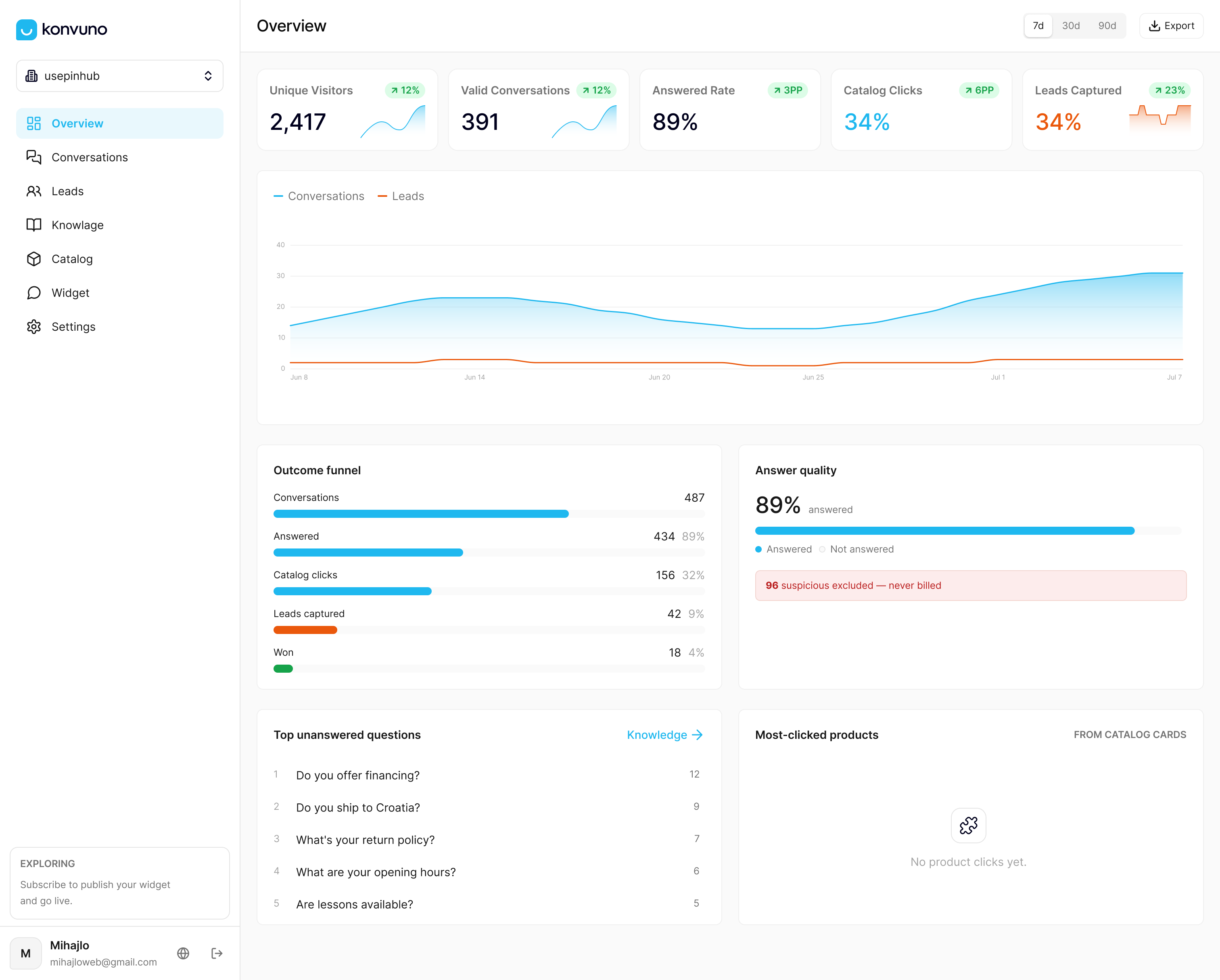
Pair it with the checklist above: set your questions, your lead form and your retention choices in the dashboard, then publish.
FAQ
Does GDPR apply to my live chat if my business is in the US?
Yes, if you offer goods or services to people in the EU or monitor their behavior. Where your company is registered does not decide it. Who your visitors are and what you do with their data does.
Do I need consent before a visitor can use the chat?
Not always. Answering a visitor’s question can rest on contract or legitimate interests. Consent becomes relevant for extras such as marketing follow-ups or using transcripts for AI training, and it must be a clear opt-in that is as easy to withdraw as to give.
Is a chat transcript personal data?
Yes, when it can be linked to a person, which includes through an email address, IP address or cookie ID. Visitors also often type details such as order numbers and addresses into the message itself, so treat whole transcripts with care.
What should I do when someone asks me to delete their chats?
Confirm their identity, find every conversation and lead record tied to them, delete or export it, and tell your chat provider if it holds copies. Keep a note of the date. Deletion can be refused only where a legal obligation or legal claim requires you to keep the data.
Do I need a data processing agreement with my chat vendor?
Yes. Article 28 requires a binding contract with any processor that handles personal data for you, covering subject, duration, purposes, data types and security. Keep it on file along with the vendor’s subprocessor list.
Sources
- Application of the GDPR, European Commission
- Legal grounds for processing data, European Commission
- Regulation 2016/679 on EUR-Lex
- Regulation 2016/679 text with Articles 28 and Chapter V
- A guide to lawful basis, ICO
- UK GDPR text on legislation.gov.uk
- 72-hour GDPR rules