Chatbot Conversion Rate: How to Measure It and Improve It
What a chatbot conversion rate really measures, how to calculate it on your own site, what to compare it with, and how small teams can raise it step by step.

Your chatbot conversion rate is the share of chatbot conversations that end in an action you care about, such as a captured lead, a booked call or a purchase. The number worth chasing is your own: published benchmarks mix different industries, definitions and traffic, so the useful comparison is your chatbot’s rate against your site’s baseline and against your own last month. If you run a small site without a support team, the fastest way to get that number is an assistant that captures leads into a built-in CRM and reports what visitors ask, which is what Konvuno does.
TL;DR
- Define one conversion per chatbot goal (lead, sale or resolved question) before you read any benchmark.
- Chatbot conversion rate = conversations with the goal action ÷ total conversations, tracked over a fixed period.
- Compare it with your site’s own conversion rate and your own history, not with a headline percentage from a vendor page.
- The biggest levers are answer quality, a clear next step inside the chat and a smooth handoff to a human.
- Change one thing at a time and judge it over enough conversations, even on low traffic.
Table of Contents
- What a chatbot conversion rate actually measures
- How to calculate it on your own site
- What counts as a good rate
- The factors that move the number
- How a small business can improve and test it
- Measuring each goal without fooling yourself
- Where Konvuno fits
- Our perspective
- FAQ
- Sources
What a chatbot conversion rate actually measures
A conversion is any visitor action that matters to the business. The chatbot version asks how many chats ended with that action. Three goals cover most small sites:
- Lead generation: the visitor leaves an email, phone number or booking request. The conversion is a qualified lead captured.
- E-commerce: the visitor completes a purchase after talking to the assistant. The conversion is an order.
- Support: the visitor gets an answer and does not need a human. Here the usual measure is the share of questions resolved without a ticket, often called deflection, not conversion. We cover why that number needs care in our piece on ticket deflection.
Mixing these goals is the most common reason two chatbot rates cannot be compared. A store counting purchases and a consultancy counting email captures are measuring different things, even if both call the result “conversion rate.”
There is early academic evidence that conversational lead capture can beat static pages. A 2025 paper in the Journal of Business Research ran two field experiments with over 16,000 participants and found WhatsApp-based chatbots produced more and higher-quality B2B leads than conventional landing pages. That is one channel and one setting, so treat it as a direction, not a promise for your site. For a broader view of where chatbots fit in a business, see the role of chatbots in business.
How to calculate it on your own site
The formula is short:
Chatbot conversion rate = chats that reached the goal ÷ total chats × 100
A worked example: your assistant handled 400 conversations in a month. 36 visitors left contact details and 9 of them booked a call. If your goal is lead capture, the rate is 36 ÷ 400 = 9%. If your goal is booked calls, it is 9 ÷ 400 = 2.25%. Both are valid. They answer different questions, so pick one as the headline and report the other as a step in the funnel.

Choose the denominator on purpose
There are two sensible denominators, and you should name which one you use:
- All chat sessions that the widget opened. This is the honest rate for the chatbot as a channel.
- All site visitors who saw the widget. This is lower, but it shows the chatbot’s effect on the whole site.
Do not mix them month to month. Also exclude your own test chats, or they will inflate the numbers on a small site.
Track the conversion event
The measurement itself needs one event that fires when the goal happens: a form submitted inside the chat, a lead saved, a checkout completed after a chat. In Google Analytics 4, these are marked as key events, and the session key event rate divides sessions with a key event by all sessions. That gives you the site-level number to place next to your chatbot number.
If you want the full setup, our chatbot conversion tracking guide walks through events and attribution, and the analytics setup guide for small sites covers the dashboards. With Konvuno, captured leads land in the built-in CRM and the dashboard shows conversations and leads together, so the numerator is already counted for you.
What counts as a good rate
Search the topic and you will find figures from single digits to 70%. They are not wrong so much as incomparable: different goals, different traffic quality, different ways of counting a “conversation.” A chat opened by a visitor who already wants to buy converts far better than a chat that pops up on every page load.
Use these three comparisons instead:
| Compare with | What it tells you | Fair or not |
|---|---|---|
| Your site’s overall conversion rate | Whether chatting visitors act more than the average visitor | Fair, same traffic |
| Your contact form’s rate | Whether chat captures leads better than a static form | Fair, same goal |
| Your chatbot last month | Whether changes helped | Fairest of all |
Expect chat sessions to convert higher than the site average, because people who start a conversation are already interested. That is selection, not magic, so do not claim the whole difference as lift. What matters is that the trend moves up after you improve answers, and that the leads are ones your team can actually work.
If someone asks whether 2.5% or 12% is “good,” the answer is the same: good against what, counted how? A 2.5% rate on all store visitors can be excellent. A 2.5% rate on people who chose to chat probably signals a problem with answers or next steps.
The factors that move the number
What decides whether a conversation ends in a lead or a sale is mostly practical.
Answers that are right and current
A visitor asking about price, stock, shipping or opening hours wants one correct answer fast. Wrong or stale answers end the chat and the trust with it. For online shops, this is where product data matters: Konvuno syncs catalogs automatically from WooCommerce or any Google Merchant or Facebook product feed, so answers about products, prices and availability stay current without manual updates.
A clear next step inside the chat
A chat that answers and then goes quiet loses the visitor. Good flows ask for the next action at the moment of interest: a size recommendation followed by a link to the product, a pricing answer followed by an offer to book a call. Our pre-sales questions guide lists the questions to cover first, and the lead qualification piece shows how to ask for contact details without scaring people away.
Language
Visitors convert more easily in the language they think in. If your traffic is not only English-speaking, an assistant that answers in the visitor’s language removes a barrier your contact form cannot. Konvuno speaks 7 languages.
A graceful handoff
Some questions need a person: a custom quote, a complaint, a complicated order. When the bot hands off cleanly, the visitor keeps going instead of leaving. Konvuno hands off to a human when a question needs one. For the mechanics, read the human handoff playbook.
Timing and placement
A widget that opens itself on every page interrupts people. One that appears on pricing, product and contact pages, where intent is highest, tends to collect better conversations. Check this in your own data: compare the conversion rate by page rather than guessing.
How a small business can improve and test it
You do not need a data team. You need a loop.
- Set the baseline. Run the assistant for two to four weeks and record chats, goal actions and rate.
- Read the actual questions. The questions visitors ask show what your site fails to answer. Fix the top ten in your knowledge base first.
- Fill the gaps in content. Every question the bot could not answer is either missing content or a missing handoff rule.
- Change one thing. Rewrite the greeting, move the widget to different pages or change the lead request. Keep everything else still.
- Wait for enough conversations. On low traffic, a week of 30 chats proves little. Judge over a longer window or a bigger change. Our guide on A/B tests that work with low traffic explains how.
- Check lead quality. More leads that never answer your email is not progress. Count the leads that became calls or orders.
If you also want to cut repetitive support questions, the 30-day pilot approach and the three must-haves for repetitive questions fit the same loop.
Learn from the questions, not only the rate
A rate tells you how well chats finish. The questions tell you why. If a quarter of chats ask about delivery times and the bot sends people to a generic page, the fix is a clear delivery answer, not a cleverer greeting. Konvuno’s analytics show what visitors actually ask, so you can see the topics that stall conversations and fix them in the dashboard.
Measuring each goal without fooling yourself
A few traps make a rate look better or worse than it is.
- Counting every email as a lead. Separate a real inquiry from a throwaway address and track qualified leads.
- Counting purchases that would have happened anyway. A returning customer who chats and buys is not proof the chat caused the sale. Compare with similar visitors who did not chat.
- Including proactive pop-ups in the denominator. Sessions where the visitor never replied dilute the rate. Report engaged chats as a separate line.
- Switching definitions. Changing what counts as a conversion mid-quarter breaks every comparison after it.
- Treating support deflection as conversion. A high deflection rate can hide unsolved issues, as we explain in the ticket deflection article. Pair it with a check that the visitor did not come back with the same problem.
Where Konvuno fits
Konvuno is an AI website assistant for small and medium businesses. You add one script tag to your site and configure everything in a hosted dashboard, with no developers and no per-seat pricing. The assistant answers from your own FAQs, website content and product catalog, captures leads into a built-in CRM and hands off to a human when needed. You can configure and preview it before you pay.
Plans are Starter at €29 per month, Growth at €79 per month and Business at €199 per month, all listed on konvuno.com. Every plan includes full conversational catalog capabilities.
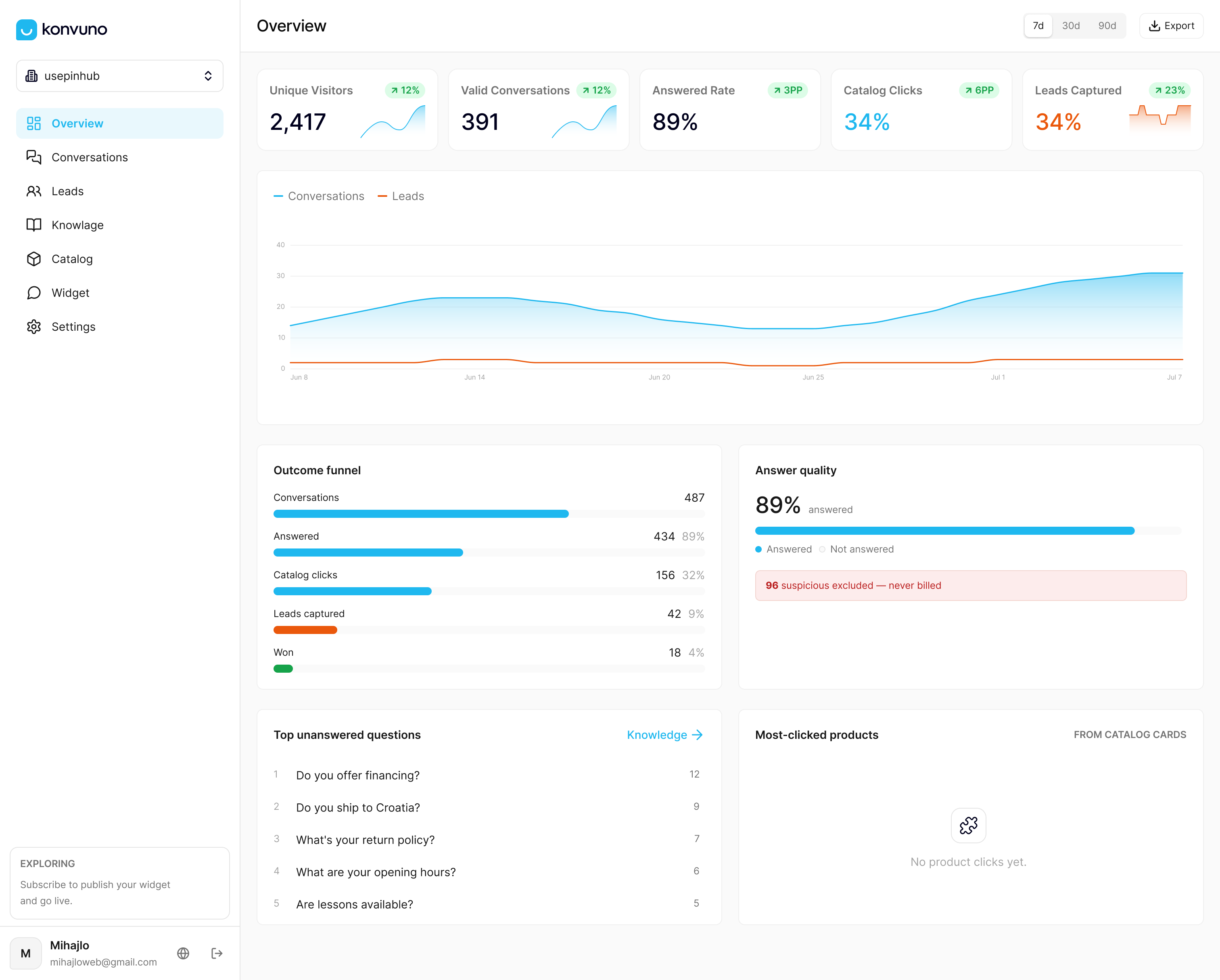
If your goal is to turn the traffic you already have into leads, start by setting up the assistant on your site and let the conversation and lead data build your baseline.
Our perspective
Most conversion-rate articles start with a big percentage and ask you to feel behind. We think that is backwards. The rate that matters is the one you can explain: which goal, which denominator, which pages.
What we see as the real work is unglamorous. A visitor asks a question, gets a correct answer, and is offered one clear next step. That is why we built Konvuno around your own FAQs, site content and a catalog that syncs from WooCommerce or a Google Merchant or Facebook feed: the answers stay right without someone retyping them.
We also believe owners should be able to do this alone. One script tag, a dashboard, a preview before you pay and no seats to count. When the owner can read the conversations, see the leads and change an answer in minutes, the conversion rate improves because the loop is short.
Start with one goal, measure it honestly, fix the top questions, repeat.
Konstantin
FAQ
What is a good chatbot conversion rate?
There is no single good number, because goals and traffic differ. Compare your chatbot with your site’s overall conversion rate, with your contact form and with your own previous month. A steady rise in qualified leads or orders matters more than any headline percentage.
How do I calculate chatbot conversion rate?
Divide the chats that reached your goal by total chats, then multiply by 100. If 36 of 400 chats ended with a captured lead, the rate is 9%. Pick the goal and denominator once and keep them fixed.
Is chatbot conversion the same as ticket deflection?
No. Conversion counts goal actions such as leads or purchases, while deflection counts questions resolved without a human. They answer different questions, so track them separately.
Can a small site test changes with low traffic?
Yes, if you change one thing at a time and judge over a longer window. Bigger changes, such as a new lead request or widget placement, show effects sooner than small wording tweaks.
Sources
- Journal of Business Research 2025 study on WhatsApp chatbots and B2B leads (EconPapers)
- Key event rate in Google Analytics 4 explained (Analytics Mania)