Chatbot Tone of Voice: How to Choose, Write and Test It
Learn how to pick a chatbot tone of voice that fits your brand, with the four tone dimensions, before-and-after examples, a voice template and a testing routine.

Your chatbot’s tone of voice is how it sounds in text: the word choices, sentence length, warmth and formality that tell a visitor whether they are talking to a brand they can trust. You choose it by placing your brand on four spectrums, writing a short voice description with examples and hard rules, and then testing it on the moments that matter most: confusion, frustration and questions the bot cannot answer.
This guide walks through that process for a small business with a website and no support team. It uses plain examples you can adapt today.
TL;DR
- Tone is how your assistant sounds in a given moment. Voice is the stable baseline underneath it. Persona is the whole identity.
- Place your brand on four spectrums: formality, humor, respectfulness and enthusiasm. Pick a point on each, not an extreme.
- Write a voice description of five to seven sentences, add in-brand and out-of-brand example pairs, and set hard rules such as “no emoji in refund threads”.
- Test the tone where it is most likely to break: frustrated visitors, unknown answers, errors and other languages.
- Decide in advance when the assistant hands off to a human, and make that handoff sound like your brand too.
Table of Contents
- What chatbot tone of voice actually means
- Why tone matters to customers and your brand
- The four dimensions you can adjust
- How to choose a tone that fits your business
- Chatbot tone of voice examples
- Write your voice down
- Test the tone before visitors do
- Tone in hard moments: handoff and unknown answers
- Common tone mistakes
- Perspective
- Put your tone into practice with Konvuno
- FAQ
- Sources
What chatbot tone of voice actually means
Tone of voice is the emotional coloring of a message. Two replies can carry identical information and still feel completely different. Compare these answers to a visitor asking about shipping:
- “Shipping takes 3 to 5 business days.”
- “Good news: your order should reach you in 3 to 5 business days.”
- “Standard delivery time is three to five business days from the dispatch date.”
Same fact, three different brands. The first is brisk, the second is friendly, the third is formal.
People often use persona, voice and tone as synonyms. A useful way to separate them: persona is the assistant’s recognizable identity in conversation, voice is its relatively stable baseline way of sounding, and tone is how that voice adjusts to the situation, so that different interactions still feel like the same assistant (Dr. Carmen Martinez on persona, voice and tone). A friendly shop assistant sounds a little lighter when it recommends a gift and a little steadier when it explains a delayed order. It is still the same character.
For a small business this matters because you do not have a support team to smooth over rough edges. The chatbot is often the first voice a visitor hears from you, and sometimes the only one.
Why tone matters to customers and your brand
A visitor cannot see your shop, your face or your packaging. On a website, the words are the service. A bot that sounds stiff in a casual brand, or jokey during a complaint, creates a small mismatch that visitors notice even if they cannot name it.
Nielsen Norman Group’s research on tone makes the underlying point: a product’s tone of voice communicates how an organization feels about its message, and the way it is expressed shapes how people read the organization behind it (NN/G, The Four Dimensions of Tone of Voice). A chatbot is a product’s voice in its purest form, because it is nothing but language.
Three practical effects follow:
- Trust. Clear, calm answers make a visitor more willing to share an email address or a question that leads to a sale.
- Consistency. If your website copy sounds warm and your bot sounds like a legal notice, visitors feel two different companies.
- Handling pressure. The tone that matters most is not the welcome line but the tone the assistant uses when the user is blocked, frustrated or uncertain, which is when trust is won or lost (Martinez).
The four dimensions you can adjust
NN/G describes tone along four dimensions, each a spectrum rather than a yes-or-no choice: formality (formal to casual), humor (serious to funny), respectfulness (respectful to irreverent) and enthusiasm (matter-of-fact to enthusiastic) (NN/G). That gives you four dials to set.
| Dimension | One end | Other end | Example of the middle |
|---|---|---|---|
| Formality | “We would be delighted to assist you.” | “Yep, happy to help!” | “Happy to help. What do you need?” |
| Humor | “Your order has shipped.” | “Your order just left the building!” | “Your order is on its way.” |
| Respectfulness | “Thank you for your patience.” | “Okay, that’s on you.” | “Thanks for waiting.” |
| Enthusiasm | “The jacket is available in blue.” | “Great pick! It comes in blue!” | “It comes in blue, and it’s in stock.” |
Most small businesses should land in the middle on humor and respectfulness, and decide deliberately on formality and enthusiasm. Respectfulness is the dial to protect: even a playful brand should never sound irreverent toward a customer with a problem.
How to choose a tone that fits your business
Start from what already exists. Your website, packaging and emails already carry a voice, and your bot should sound like their quieter cousin, not a stranger.
Start with your brand and your customer
Read your own About page, your product descriptions and your last twenty customer emails. Underline the words you naturally use. Do you say “order” or “purchase”? “Hi” or “Hello”? “We” or “the company”? Those choices are your raw material.
Then picture the person asking. A visitor checking whether a dress is in stock at 11 p.m. wants speed and friendliness. A visitor asking a clinic about appointment cancellation wants clarity and reassurance. A visitor comparing business software wants precision.

Match the context, not just the industry
Industry templates are a starting point, but the situation inside the conversation shifts the right tone:
- Product questions: light, quick, helpful. Short sentences, concrete details.
- Pricing and policy questions: plain and exact. No jokes, no hedging.
- Complaints and problems: calm, direct, apologetic where warranted, and with a clear next step.
- Lead capture: warm and low-pressure. Explain why you are asking for an email.
Consider language and region
Language is not universal even within one language. AWS notes that an assistant serving the American South needs different vocabulary than one serving UK users, and that a Spanish-speaking assistant for Mexico City needs different formality markers than one for Buenos Aires (AWS Public Sector Blog). If your site serves several languages, define the tone per language instead of translating your English rules word for word. Formal and informal forms of “you” in many languages are a tone decision, not a grammar detail. For more on keeping replies natural across languages, see our guide on conversation QA for bilingual website chat.
Chatbot tone of voice examples
The fastest way to understand tone is to see one message written several ways. Here are five common situations, each in three tones: Crisp, Friendly and Formal.
Greeting
- Crisp: “Hi. Ask me about products, shipping or returns.”
- Friendly: “Hi there! I can help with products, shipping and returns. What’s on your mind?”
- Formal: “Welcome. I can assist with questions about our products, delivery and returns.”
Product availability
- Crisp: “Yes, the size M is in stock.”
- Friendly: “Good news, size M is in stock and ready to ship.”
- Formal: “The medium size is currently available.”
Visitor is frustrated about a late order
- Crisp: “Sorry about the delay. Share your order number and I’ll pass this to our team.”
- Friendly: “I’m sorry your order is late, that’s frustrating. Send me the order number and I’ll get a person on it.”
- Formal: “We apologize for the delay. Please provide your order number and a team member will review it.”
The assistant does not know the answer
- Crisp: “I don’t have that information. Want me to connect you with someone?”
- Friendly: “I’m not sure about that one, and I don’t want to guess. Shall I bring in a teammate?”
- Formal: “I am unable to confirm that. I can transfer you to a member of our staff.”
Asking for contact details
- Crisp: “What’s your email? We’ll send the quote there.”
- Friendly: “Happy to send you a quote. What’s the best email for it?”
- Formal: “To prepare your quote, please provide your email address.”
Notice what stays constant: every version is honest about what it does not know, every one gives a next step, and none of them blames the visitor. Those are voice rules, not tone choices.
Write your voice down
A tone you carry in your head will drift. Write it down in a form the assistant, and any teammate editing it, can follow.
A short voice description
FutureAGI recommends a voice description of five to seven sentences built on adjective pairs that say what the voice is and what it is not, such as sharp and warm but not chirpy (FutureAGI, Evaluating LLM Personas and Style). The “not” half is what stops the voice from sliding into generic politeness.
A sample for a home goods shop:
We sound like a helpful shop owner who knows the stock. Warm but not gushing. Direct without being curt. We use plain words and short sentences. We never joke when a customer is upset. We say “order”, not “purchase transaction”.
Example pairs and hard rules
The same source suggests collecting 10 to 20 example pairs of in-brand and out-of-brand replies, plus a short list of hard rules (FutureAGI). Pairs are powerful because they show the boundary:
- In brand: “I’m sorry about that. I’ll get a teammate to look at it.”
- Out of brand: “Oops! Looks like something went wrong, but no worries!!”
Hard rules are the lines that never move. Good candidates:
- Reply length: two to four sentences for simple questions.
- No emoji in refund, complaint or legal conversations.
- No slang that will age badly.
- Never promise a delivery date, price or discount that is not in your content.
- Always offer a human when the visitor asks for one.
Put the whole template in one document: voice description, example pairs, vocabulary list, hard rules. It becomes the brief for your assistant and your reference when something sounds off. If you want to go deeper on turning that brief into reliable replies, our posts on chatbot conversation design and prompt checks before you ship cover the mechanics.
Test the tone before visitors do
A tone that reads well in three samples can fall apart in the fortieth conversation. Test it deliberately.
Build a scenario matrix
AWS describes a method for turning vague personality goals into testable behavior: a matrix of scenarios such as user greeting, user frustration, error in a process and unknown answer, each with expected behaviors and example responses, validated by comparing approved examples side by side with actual outputs (AWS). You can run a small version of this on a spreadsheet:
| Scenario | Expected behavior | Approved example |
|---|---|---|
| Greeting | Short, warm, offers three topics | “Hi there! I can help with…” |
| Frustration | Apologizes once, no jokes, next step | “I’m sorry about that…” |
| Error or dead end | Admits it, offers alternatives | “That didn’t go through…” |
| Unknown answer | No guessing, offers human | “I’m not sure, and I don’t want to guess…” |
If you want a fuller approach to defining behaviors and edge cases, this walkthrough on building an escalation policy for AI agents shows how scenarios and expected responses fit together.
Score real examples
For teams with more volume, FutureAGI suggests a hold-out set of 100 to 200 examples scored by two reviewers, and tracking agreement between them, with a Cohen’s kappa above 0.6 to ship and above 0.75 to trust as a release gate (FutureAGI). A small shop does not need that rigor on day one. A lighter version: write 30 real questions from your inbox, run them through the assistant, and have two people mark each reply “sounds like us” or “doesn’t”. Where you disagree, your voice description is too vague.
Our guide on how to test chatbot replies goes through a routine you can repeat after every content change, and low-traffic A/B tests help you compare two tones once you have enough conversations.
Check stability and languages
Test tone across a long conversation, not only the first reply. Does the assistant stay in character on turn ten? FutureAGI also recommends checking persona stability across turns and how style carries across languages, including Spanish, German and Japanese (FutureAGI). If you serve visitors in several languages, read a sample of replies in each with a native speaker, and look at how private multilingual AI deployments approach language variation when you want a wider view. Our posts on language detection and language fallbacks show what to do when the visitor’s language is unclear.
Tone in hard moments: handoff and unknown answers
The test of a tone is not the greeting. It is the moment the assistant reaches its edge.
Three habits keep the voice steady there:
- Say what you do not know. “I’m not sure” in your brand’s voice builds more trust than a confident wrong answer.
- Hand off with a reason and a next step. “This needs a person. I’m passing it to our team, and they’ll reply by email” beats a silent transfer.
- Decide the triggers in advance. Typical ones are a visitor asking for a human, strongly negative sentiment, legal or chargeback language, or a problem involving a damaged or missing high-value item.
Write the handoff message with the same care as the greeting, and keep the same vocabulary. Our human handoff playbook covers the implementation side.
Common tone mistakes
- Copying a template unchanged. Industry templates are useful scaffolding, but a generic tone is the one that makes every bot sound alike.
- Over-enthusiasm. Exclamation marks on every line wear thin fast, especially when the visitor is annoyed.
- Humor on autopilot. Jokes need a rule for when they stop.
- Unwritten rules. If nobody wrote down “no emoji in refunds”, the assistant will eventually use one.
- One tone for every language. Direct translation of English friendliness can read as rude or overfamiliar elsewhere.
- Never reviewing. Visitors tell you what is unclear through their questions. Read the conversations and adjust.
Perspective
We think tone is the cheapest way for a small business to look bigger than it is, and the easiest to get wrong because nobody owns it.
Most owners we talk to have no support team. They answer the same ten questions every day, and their site already says what they want to say. The assistant’s job is to say it the same way the owner would, at 2 a.m., in a visitor’s own language, and to step aside gracefully when a person is needed.
That is why we built Konvuno so the owner configures everything from a dashboard, without a developer, and can preview how the assistant answers before paying. Tone is something you tune by reading real replies, not by guessing. The analytics on what visitors actually ask tell you which moments deserve the most careful wording, and answers drawn from your own FAQs, pages and synced product catalog keep the content and the voice rooted in how you already speak.
Our advice: write five sentences about how your business sounds, write five example replies, and judge the assistant against those, not against a generic idea of “friendly”.
Konstantin
Put your tone into practice with Konvuno
If you want an assistant that answers from your own FAQs, website content and product catalog, Konvuno gives you a single script tag to install and a hosted dashboard to configure it. There are no per-seat fees and no developer is required. Catalogs sync from WooCommerce or any Google Merchant or Facebook product feed, the assistant captures leads into a built-in CRM, and it hands off to a human when a question needs one. It speaks 7 languages, which makes the per-language tone work above practical to apply.
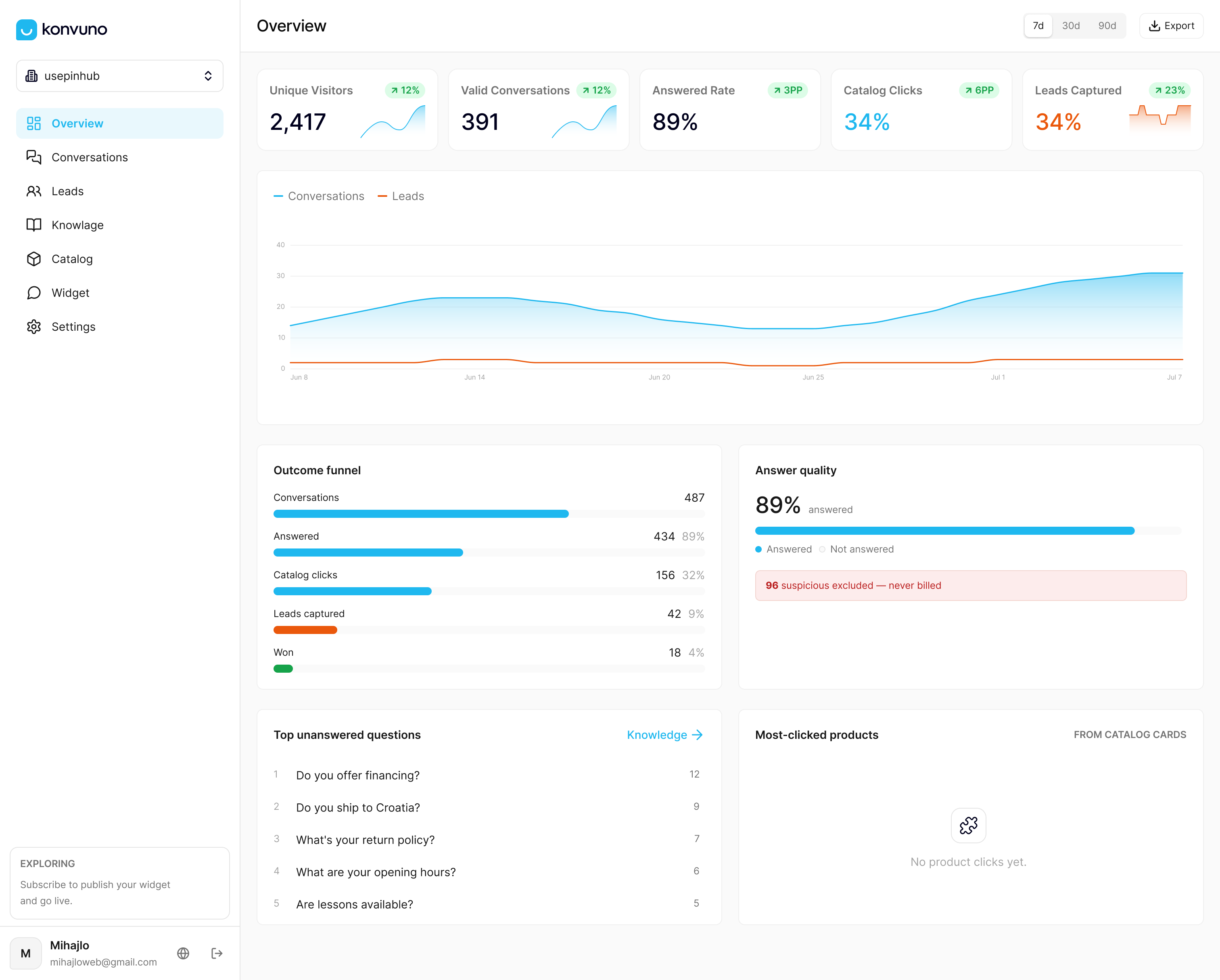
Plans are Starter at €29 per month, Growth at €79 per month and Business at €199 per month. You can configure and preview before you pay, so you can check your voice rules against real questions first. See the plans on the Konvuno site.
FAQ
What is the tone of voice of a chatbot?
It is how the chatbot sounds in writing: its word choice, sentence length, warmth and formality. It is the emotional coloring of the reply, separate from the facts in it. A good tone fits your brand and shifts slightly with the situation, such as a greeting versus a complaint.
What are examples of chatbot tone?
The same shipping answer can be crisp (“Shipping takes 3 to 5 business days”), friendly (“Good news, it should reach you in 3 to 5 business days”) or formal (“Delivery takes three to five business days from dispatch”). Pick the one your brand would say out loud, and keep it consistent across the conversation.
How do I choose a tone for my chatbot?
Start with your existing website copy and customer emails, then place your brand on the four tone dimensions: formality, humor, respectfulness and enthusiasm. Write a short voice description with in-brand and out-of-brand examples, and add hard rules. Then test it on frustrated visitors, unknown answers and every language you serve.
Should a chatbot use humor or emoji?
Only if your brand already does, and with rules. Keep humor and emoji out of complaints, refunds and legal topics, where a light tone can feel dismissive. Writing that rule down in advance keeps the assistant consistent.
Sources
- The Four Dimensions of Tone of Voice, Nielsen Norman Group
- Evaluating LLM Personas and Style (2026), FutureAGI
- Turning vague agent personality goals into versioned prompts, AWS Public Sector Blog
- What Makes a Bot Feel Consistent? Persona, Voice, and Tone